25.6.06

CNN.com - Cheney: Iraq pullout 'worst possible thing we could do' - Jun 22, 2006

CNN.com - Cheney: Iraq pullout 'worst possible thing we could do' - Jun 22, 2006

Cheney: Iraq pullout 'worst possible thing we could do'

Spoken like our true Dick.
Thursday, June 22, 2006; Posted: 8:22 p.m. EDT (00:22 GMT)
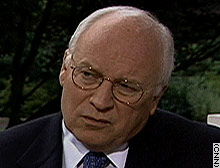
story.cheney.cnn.jpg
"If we pull out, they'll follow us," Vice President Cheney said of terrorists in Iraq. So? What is border patrol for, DICK?

SPECIAL REPORT

Your e-mails: After al-Zarqawi
Tracking Terror: Who's next?
Interactive: Iraq's population

WASHINGTON (CNN) -- Withdrawing American troops from Iraq would embolden terrorists and leave the United States and its allies vulnerable to new attacks, Vice President Dick Cheney said Thursday.

"The worst possible thing we could do is what the Democrats are suggesting," Cheney told CNN's John King in an interview at the vice president's residence.

Some Democrats have urged an immediate withdrawal of U.S. troops from Iraq. Others have pushed for a phased troop withdrawal. (Watch Dick Cheney explain that withdrawal "in effect validates the terrorists' strategy" -- 3:29)

The Senate voted 86-13 on Thursday against a proposal offered by Democratic Sens. John Kerry of Massachusetts and Russ Feingold of Wisconsin that would have required all U.S. troops be withdrawn from Iraq by July 2007. (Full story)

The Senate also rejected a proposal by Sen. Carl Levin by a vote of 60-39 that would have required a drawdown to begin by the end of the year but not set a timetable for a complete withdrawal.

Neither an immediate nor phased withdrawal would confer any protection on the United States, Cheney said. "If we pull out, they'll follow us," he said of terrorists.

"It doesn't matter where we go. This is a global conflict. We've seen them attack in London and Madrid and Casablanca and Istanbul and Mombasa and East Africa. They've been, on a global basis, involved in this conflict. (Read the full interview transcript)

"And it will continue -- whether we complete the job or not in Iraq -- only it'll get worse. Iraq will become a safe haven for terrorists. They'll use it in order to launch attacks against our friends and allies in that part of the world."

Cheney said a pullout would signal the United States would not stand its ground in the war on terror.

"No matter how you carve it -- you can call it anything you want -- but basically, it is packing it in, going home, persuading and convincing and validating the theory that the Americans don't have the stomach for this fight."

North Korea strike dismissed

On North Korea and its possible test of a long-range ballistic missile, Cheney rejected a pre-emptive U.S. military strike, saying current diplomatic moves can deal with the issue.

"I think, at this stage, we are addressing the issue in the proper fashion," he said. "Obviously, if you are going to launch strikes at another nation, you better be prepared to not fire just one shot. The fact of the matter is, I think, the issue is being addressed appropriately."

Cheney was asked about a Thursday op-ed piece in The Washington Post from William Perry, defense secretary under President Clinton, and Ashton Carter, Clinton's assistant secretary of defense, which said the United States, if necessary, should strike beforehand and destroy the missile before North Korea tests it.

Cheney said that, while "I appreciate Bill's advice," such an action could worsen the situation.

Cheney declined to comment on the CIA leak investigation saying he might be called as a witness.

But he did offer support for his former chief of staff, I. Lewis "Scooter" Libby, who faces perjury and obstruction of justice charges in the probe of the leak of the identity of an undercover CIA officer.

Libby is "one of the finest men I've ever known," Cheney said. "He's entitled to the presumption of innocence."

The administration's 'Darth Vader'?

Asked if it were true he's become a "dark, nefarious source in the administration," Cheney said, "I suppose sometimes people look at my demeanor and say, 'Well, he's the Darth Vader of the administration.' "

Cheney was unequivocal about his plan not to seek another political office.

"My career will end politically with this administration," he said. "I have the freedom and the luxury, as does the president, of doing what we think is right for the country. ... We're not trying to improve our standing in the polls; we're not out there trying to win votes for ourselves."

Asked about those polls -- Cheney's approval rating is lower than the president's -- the vice president said, "We don't worry about the polls -- they go up, the polls go down. The fact of the matter is we're doing what we think best for the nation. And that's what the American people elected us to do.

"History will judge this president as a very successful, very effective leader," he said. "And I'm proud to be part of his team."

21.6.06

Police Got Phone Data from Brokers

Police Got Phone Data from Brokers
by Ted Bridis and John Solomon
Numerous federal and local law enforcement agencies have bypassed subpoenas and warrants designed to protect civil liberties and gathered Americans' personal telephone records from private-sector data brokers.

These brokers, many of whom advertise aggressively on the Internet, have gotten into customer accounts online, tricked phone companies into revealing information and even acknowledged that their practices violate laws, according to documents gathered by congressional investigators and provided to The Associated Press.

The law enforcement agencies include offices in the Homeland Security Department and Justice Department — including the FBI and U.S. Marshal's Service — and municipal police departments in California, Colorado, Florida, Georgia and Utah. Experts believe hundreds of other departments frequently use such services.

"We are requesting any and all information you have regarding the above cell phone account and the account holder ... including account activity and the account holder's address," Ana Bueno, a police investigator in Redwood City, Calif., wrote in October to PDJ Investigations of Granbury, Texas.

An agent in Denver for U.S. Immigration and Customs Enforcement, Anna Wells, sent a similar request on March 31 on Homeland Security stationery: "I am looking for all available subscriber information for the following phone number," Wells wrote to a corporate alias used by PDJ.

Congressional investigators estimated the U.S. government spent $30 million last year buying personal data from private brokers. But that number likely understates the breadth of transactions, since brokers said they rarely charge law enforcement agencies any price.

PDJ said it always provided help to police for free. "Agencies from all across the country took advantage of it," said PDJ's lawyer, Larry Slade of Los Angeles.

A lawmaker who has investigated the industry said Monday he was concerned by the practices of data brokers.

"We know law enforcement has used this because it is easily obtained and you can gather a lot of information very quickly," said Rep. Ed Whitfield, R-Ky., head of the House Energy and Commerce investigations subcommittee. The panel expects to conduct hearings this week.

Whitfield said data companies will relentlessly pursue a target's personal information. "They will impersonate and use everything available that they have to convince the person who has the information to share it with them, and it's shocking how successful they are," Whitfield said. "They can basically obtain any information about anybody on any subject."

The congressman said laws on the subject are vague: "There's a good chance there are some laws being broken, but it's not really clear precisely which laws."

James Bearden, a Texas lawyer who represents four such data brokers, compared the companies' activities to the National Security Agency, which reportedly compiles the phone records of ordinary Americans.

"The government is doing exactly what these people are accused of doing," Bearden said. "These people are being demonized. These are people who are partners with law enforcement on a regular basis."

The police agencies told AP they used the data brokers because it was quicker and easier than subpoenas, and their lawyers believe their actions were lawful. Some agencies, such as Immigrations and Customs Enforcement, instructed agents to stop the practice after congressional inquiries.

The U.S. Marshal's Service told AP it was examining its policies but compared services offered by data brokers to Web sites providing public telephone numbers nationally.

None of the police agencies interviewed by AP said they researched these data brokers to determine how they secretly gather sensitive information like names associated with unlisted numbers, records of phone calls, e-mail aliases — even tracing a person's location using their cellular phone signal.

"If it's on the Internet and it's been commended to us, we wouldn't do a full-scale investigation," Marshal's Service spokesman David Turner said. "We don't knowingly go into any source that would be illegal. We were not aware, I'm fairly certain, what technique was used by these subscriber services."

At Immigration and Customs Enforcement, spokesman Dean Boyd said agents did not pay for phone records and sought approval from U.S. prosecutors before making requests. Their goal was "to more quickly identify and filter out phone numbers that were unrelated to their investigations," Boyd said.

Targets of the police interest include alleged marijuana smugglers, car thieves, armed thugs and others. The data services also are enormously popular among banks and other lenders, private detectives and suspicious spouses. Customers included:

_A U.S. Labor Department employee who used her government e-mail address and phone number to buy two months of personal cellular phone records of a woman in New Jersey.

_A buyer who received credit card information about the father of murder victim Jon Benet Ramsey.

_A buyer who obtained 20 printed pages of phone calls by pro basketball player Damon Jones of the Cleveland Cavaliers.

The athlete was "shocked to learn somebody had obtained this information," said Mark Termini, his lawyer and agent in Cleveland. "When a person or agency is able to obtain by fraudulent means a person's personal information, that is something that should be prohibited by law."

PDJ's lawyer said no one at the company violated laws, but he acknowledged, "I'm not sure that every law enforcement agency in the country would agree with that analysis."

Many of the executives summoned to testify before Congress this week were expected to invoke their Fifth Amendment rights against self-incrimination and to decline to answer questions.

Slade said no one at PDJ impersonated customers to steal personal information, a practice known within the industry as pretexting.

"This was farmed out to private investigators," Slade said. "They had written agreements with their vendors, making sure the vendors were acquiring the information in legal ways."

Privacy advocates bristled over data brokers gathering records for police without subpoenas.

"This is pernicious, an end run around the Fourth Amendment," said Marc Rotenberg, head of the Washington-based Electronic Privacy Information Center, a leading privacy group that has sought tougher federal regulation of data brokers. "The government is encouraging unlawful conduct; it's not smart on the law enforcement side to be making use of information obtained improperly."

A federal agent who ordered phone records without subpoenas about a half-dozen times recently said he learned about the service from FBI investigators and was told this was a method to obtain phone subscriber information quicker than with a subpoena.

The agent, who spoke only on condition of anonymity because he is not authorized to speak with reporters, said he and colleagues use data brokers "when he have the need to act fairly quickly" because getting a subpoena can involve lengthy waits.

Waiting for a phone company's response to a subpoena can take several days or up to 45 days, said police supervisor Eric Stasiak of Redwood City, Calif. In some cases, a request to a data broker yields answers in just a few hours, Stasiak said.

Legal experts said law enforcement agencies would be permitted to use illegally obtained information from private parties without violating the Fourth Amendment's protection against unlawful search and seizure, as long as police did not encourage any crimes to be committed.

"If law enforcement is encouraging people in the private sector to commit a crime in getting these records that would be problematic," said Mark Levin, a former top Justice Department official under President Reagan. "If, on the other hand, they are asking data brokers if they have any public information on any given phone numbers that should be fine."

Levin said he nonetheless would have advised federal agents to use the practice only when it was a matter of urgency or national security and otherwise to stick to a legally bulletproof method like subpoenas for everyday cases.

Congress subpoenaed thousands of documents from data brokers describing how they collected telephone records by impersonating customers.

"I was shot down four times," Michele Yontef complained in an e-mail in July 2005 to a colleague. "I keep getting northwestern call center and they just must have had an operator meeting about pretext as every operator is clued in."

Yontef, who relayed another request for phone call records as early as February, was among those ordered to appear at this week's hearing.

Another company years ago even acknowledged breaking the law.

"We must break various rules of law in acquiring all the information we achieve for you," Touch Tone Information Inc. of Denver wrote to a law firm in 1998 that was seeking records of calls made on a calling card.

The FBI's top lawyers told agents as early as 2001 they can gather private information about Americans from data brokers, even information gleaned from mortgage applications and credit reports, which normally would be off-limits to the government under the U.S. Fair Credit Reporting Act.

FBI lawyers rationalized that even though data brokers may have obtained financial information, agents could still use the information because brokers were not acting as a consumer-reporting agency but rather as a data warehouse.

The FBI said it relies only on well-respected data brokers and expects agents to abide by the law. "The FBI can only collect and retain data available from commercial databases in strict compliance with applicable federal law," spokesman Mike Kortan said Monday.

20.6.06

U.S. Learns to Live with Less Freedom

U.S. Learns to Live with Less Freedom
by Tim Harper

Speak for yourself.
MANCHESTER, New Hampshire - The fierce cultural aversion to the long reach of government is emblazoned on every licence plate here, an omnipresent statement that should make Rich Tomasso's job easier.

But even a man who makes it his business to protect individual liberties in a state where no government would dare collect a sales tax or personal income tax — or force a seatbelt around a driver or a helmet on a motorcyclist — has to face some harsh realities in George W. Bush's America.


"People are more afraid of terror than having their privacy violated," says Tomasso, chair of the New Hampshire Liberty Alliance. "For so long the rhetoric has been about fear, not hope and more traditional American values."
"Live Free or Die" is not just a cheesy licence plate slogan in this tiny New England state.

But even New Hampshire is not immune to the national erosion of civil liberties that has permeated every part of the United States since terrorists forced their way into airline cockpits almost five years ago, taking away a nation's bravado and replacing it with fear.

The exploitation of that fear by an administration intent on inflating the powers of the presidency, at the expense of a cowed Congress and with the tacit approval of an anxious nation, may be a cautionary tale for Canadians should some of that U.S.-style fear find its way north of the border in the wake of Toronto's recent terrorism arrests.In recent years, it has become a truism that Americans will trade away some liberties because they have been attacked.

Canadians have not.
But where is that rugged U.S. individuality that had helped define this nation? "Canadians, over the past couple of decades, appear to be much more aware of civil liberties. They have the balance just about right between the sense of community and individualism," says Phillip Cooper, an expert on separation of powers at Portland State University in Oregon."I hope this politics of fear doesn't gravitate across the border. One hopes that your country won't see the polarization we have here.

Canadians look down here and see this U.S. individuality, but it has become a fearful, combative individuality."
Since Bush declared his global war on terror, "it has become a war on American citizens," says Dan Belforti, who is running for the U.S. Congress as a Libertarian candidate in New Hampshire.It started with the country — those of all political stripes — rallying around a leader who cast the U.S. as victim, declaring the rest of the world was either with him or against him. Bush and his inner circle allowed to stand the perception that the Iraq war was linked to Sept. 11, 2001 — a belief still held today by a substantial number of Americans. (we fear our Government will cause us another mass murder)

With the threat of another attack foremost in their minds, Americans looked the other way as "enemy combatants" were held without due process at Guantanamo Bay, shrugged amid revelations their government was secretly picking up terrorist suspects and flying them to countries with ugly human rights records, yawned when they were told the CIA might be holding prisoners in secret sites in Eastern Europe.


But more surprising has been the lack of pushback when they were told the Bush administration had ignored a law requiring court approval and had begun wiretapping international calls of Americans and assembling a massive databank of phone records of Americans.
In Canada, the Canadian Security Intelligence Service must get court approval before conducting any electronic surveillance, and the Communications Security Establishment needs written authorization from the minister of defence.

Here, Bush argued his constitutional power overrode the need to go to a court that took too long to give approval anyway.
More quietly, Bush has claimed, some 750 times, the authority to disobey laws he has signed — including a much-publicized ban on torture — if they conflict with his interpretation of the U.S. Constitution.

No U.S. president has ever invoked that right so many times.
The U.S. Congress has passed legislation that essentially establishes a national ID card, and there are calls for a national DNA registry of Americans.The Bush administration believes it is on the winning side when it comes to the tug between security and liberty."When you push even the harshest critic, even they say, `Yeah, we should be listening to Al Qaeda,'" a senior administration official told The Washington Post, making a reference to the wiretapping program. "So from that perspective, that's a winning (issue) and we're on the side of the public."

But there have been recent signs that the beginning of a pushback may finally be at hand."The Bush administration has been bent on a scheme for years of reducing Congress to akin to an extra in a Cecil B. DeMille political (movie) extravaganza," Bruce Fein, a justice official in Ronald Reagan's administration, told Congress recently. "(It includes) the assertion of executive privilege to deny Congress any authority to oversee executive branch operations; a claim of inherent presidential authority to flout any statute that he thinks impedes his ability to gather foreign intelligence, whether opening mail, conducting electronic surveillance, breaking and entering, or committing torture.

"
Gene Healy and Timothy Lynch of the libertarian Cato Institute have written that Bush has conferred upon himself the power to pursue any tactic he wishes to win the war on terror, simply by telling audiences he will use any "legal" means to protect the country."That is what most Americans want to hear and believe," they write. "Unfortunately, the president appears to believe that he is the ultimate arbiter of what is legal and what is illegal — at least in matters relating to national security.

"
Cooper says there is nothing unusual or wrong about people rallying around leaders in times of stress. What is wrong, he says, is when they stop paying attention to what the government is doing."There is not much doubt the administration has utilized the fear of another 9/11 and the war on terror to expand the executive power,"

Cooper says.
But he says the wakeup call might have been sounded. "People are starting to ask questions," he says. "In a way, I'm a little bit surprised that things as obscure and arcane as presidential signing statements appear to have had some staying power in the media.

"
Bush's predilection for presidential signing statements, which give him the right to ignore portions of the laws he signs, had largely gone unnoticed until late last year, when he signed an amendment to a military spending bill that banned cruel, inhuman or degrading treatment of foreign prisoners.

Then, after a highly publicized signing ceremony with the man behind the ban, Arizona Republican Senator John McCain, Bush quietly put a statement in the U.S. register giving him the right to ignore the ban if he felt it was protecting Americans from terror. BU*SH*IT

A litany of court challenges have been issued by civil liberties groups over the reported data-mining by U.S. phone companies and arguments were heard in a Detroit court last week in a legal challenge to the wiretapping program.

A Supreme Court ruling on Bush's plan to try "enemy combatants" under special military tribunals at Guantanamo could come this month and if the court rules the tribunals invalid, it could begin the process of closing the prison camp.
Revolt may finally be brewing within the ranks of Congress where Republicans facing mid-term elections in the fall are finding backbone.

Revolt is brewing in New Hampshire, too. It is the first state to openly challenge the so-called Real ID Act, approved last year and scheduled to come into effect in May 2008. Many believe it is the precursor to a national ID card.
The bill requires states to check whether driver's licence applicants are in the country legally, and to require documents showing their birthdate, social security number and home address. The act also requires that states find a way to verify the documents are valid.

If New Hampshire rejects the law, its residents will no longer be allowed to use driver's licences as required identification at airports, federal buildings and, potentially, the Canadian border."The view here is `get off my motorcycle, get out of my car, stay away from my guns and get out of my bedroom,'" says Michael Dupre, a professor of political sociology at the New Hampshire Institute of Politics."The culture of liberty is still very strong here."

Russia's 'Floating Chernobyls' to Go Ahead Despite Green Fears

Russia's 'Floating Chernobyls' to Go Ahead Despite Green Fears

by Andrew Osborn

Russia is to press ahead with the world's first floating nuclear power station despite environmental concerns. The first "floating Chernobyl" could be ready in four years.


Rendition of a proposed floating nuclear power plant. (Photo/Baltiysky Zavod)
The Kremlin has approved the project and a shipyard in the far north of Russia, used to build nuclear submarines, will begin work next year. Rosenergoatom, the country's nuclear power agency, says it intends to build up to six mobile power stations, costing £182m each, the first scheduled for use in 2010.

Sergey Kiriyenko, the head of Rosenergoatom, said: "There will be no floating Chernobyl," referring to the 1986 nuclear disaster. Sergey Obozov, a senior official at the agency, said they would be "reliable as a Kalashnikov assault rifle, which are a benchmark of safety."

But environmentalists warned that the power stations could sink in stormy weather, and could become a target for terrorists. A report from Bellona Foundation, an independent Norwegian research group, claims the floating power stations are "a threat to the Arctic, the world's oceans, and the whole concept of non-proliferation."

The structures will supply heat and electricity to far-flung corners of Russia's far east and far north where it is difficult and expensive to ship coal and oil. Russia also wants to sell the structures to other countries, including China and India.

The structures will have a service life of 40 years, require a crew of 69 people, and could power a medium-sized town. The first power station will be moored in the White Sea off the town of Severodvinsk in Russia's northern Archangel region.

I find it quite amusing, that America claims to be this 'super power' with the chutzbah to go around 'warning' other countries regarding thier use of technology (should it pose a "threat"), yet many other countries are for more technologically sophisticated. Yet we can't even get a grasp on the metric system.


Democrats Say Key Superfund Data Is Being Withheld From the Public

Democrats Say Key Superfund Data Is Being Withheld From the Public

The EPA won't release some data on 140 Superfund locations.
Senate Republicans say their rivals may want to reinstate a cleanup fee.
by T. Christian Miller

WASHINGTON - Senate Democrats on Thursday accused the Bush administration of withholding key details about toxic waste sites that present risks of exposure to nearby residents.

At a congressional hearing, Sen. Barbara Boxer (D-Calif.) said the Environmental Protection Agency had designated as confidential the details of about 140 Superfund sites where toxic exposure remained uncontrolled.

Boxer and other Democrats said the secret data included information about how much money and time it would take to clean up the dangerous sites, including one site where the EPA predicted it would take 26 years to close off access to toxics.

"This isn't a question of left or right," Boxer said, waving a document marked "Privileged" by EPA officials to prevent its release to the public. "This is a question of right and wrong."

The EPA said that it had blocked only information related to law enforcement and that the public had access to all relevant health-risk data for the sites, seven of which are in California.

"There is far more information available for each [high-priority] site than has ever been available before," said Susan Parker Bodine, the assistant administrator responsible for the Superfund program, which was designed to clean up toxic waste sites such as chemical dumping grounds and contaminated factories.

Republicans said Democrats were trying to manufacture a political issue, and noted that Senate tradition had long prevented the release of sensitive information.

They also said they feared that Democrats were seeking to reinstate a controversial tax in which chemical manufacturers and other companies were forced to pay a fee to contribute to cleaning up waste sites, even if the firms played no role in creating the mess.

"This tax would fall on businesses already paying for their own cleanup or that had never created any kind of a Superfund site," said Sen. James M. Inhofe (R-Okla.), chairman of the Senate environment committee. "It would put a burden on those companies."

Democrats have routinely accused the Bush administration of restricting access to information designed to protect the public. One Republican-sponsored bill moving through Congress would limit data available on toxic substances released into communities, and the U.S. Army Corps of Engineers has blocked information on flooding dangers in Florida.

Thursday's hearing of the Superfund and waste management subcommittee was the first in four years. The Superfund program was created almost three decades ago in response to environmental disasters such as Love Canal, a neighborhood in Niagara Falls, N.Y., where chemical contamination forced the removal of 800 families and led to $200 million in remediation costs.

The cleanup effort has drawn criticism ever since, from environmentalists who claim it is underfunded and too slow, and from industry officials who say it is costly and punitive.

Bodine said that the agency had made significant progress, but that larger, more costly projects — including many of the 140 sites at issue at Thursday's hearing — take more time to remediate.

Those sites are areas where the public still faces some possible exposure to toxic substances — such as a building near buried radioactive waste that was not surrounded by a fence. A skateboard park built over the site, however, was protected by a layer of dirt.

Sen. Frank R. Lautenberg (D-N.J.) said he was disturbed by some of the answers from Bodine, who at times appeared flustered and at a loss for words under the Democrats' questions. New Jersey, with 20, has the highest number of sites with uncontrolled exposure.

The EPA's decision to withhold information is "nonsense, and everybody knows it's nonsense," Lautenberg said. "It's deceptive."

*

(BEGIN TEXT OF INFOBOBOX)

California sites

Seven California sites on the national Superfund list still present a risk of exposure to residents. The Environmental Protection Agency has refused to release details on such areas.

Ft. Ord, Marina

• Lava Cap Mine, Nevada City

• McCormick & Baxter Creosoting Co., Stockton

• Montrose Chemical Corp., Torrance

• Omega Chemical Corp., Whittier

• Sulphur Bank Mercury Mine, Clearlake

• United Heckathorn Co., Richmond

Source: EPA

US Warns North Korea against 'Provocative' Missile Test

US Warns North Korea against 'Provocative' Missile Test
by Felipe Seligman and Juliana Lara Resende
The United States sharply warned North Korea against testing a ballistic missile, saying it would take steps to protect itself as speculation mounts about an imminent launch.

"Together, our diplomacy and that of our allies has made clear to North Korea that a missile launch would be a provocative act that is not in their interests and will further isolate them from the world," said US State Department spokesman Sean McCormack.

"We have a variety of national technical means that we could use to monitor the situation. We, of course, will take necessary preparatory steps to track any potential activities and to protect ourselves," he told reporters.

North Korea on Friday accused a US reconnaissance plane of intruding over its territorial space to spy on strategic targets, amid jitters over the Stalinist country's apparent preparations for a missile test.

South Korean and US officials have said that North Korea appears to be preparing to test-launch an intercontinental ballistic missile capable of reaching the mainland United States.

On Friday, South Korean officials and analysts said that North Korea had not yet begun fueling a long-range missile on its northeast coast, the final step before a possible launch.

"It will take at least two days to fill the rocket with liquid fuel and if they finish it, we can say they are ready to start the countdown," Baek Seung-Joo from the government-backed Korean Institute for Defence Analyses told AFP.

Also on Friday, Japan warned North Korea against testing a ballistic missile, saying it would set back efforts to normalize diplomatic relations.

"If a ballistic missile is launched, it would directly affect our nation's security and constitute a violation of the Pyongyang Declaration," Chief Cabinet Secretary Shinzo Abe, the government spokesman, told reporters.

North Korea is believed to be developing the missile for a range of up to 10,000 kilometers (6,200 miles).

It shocked the world in August 1998 by firing a long-range Taepodong-1 missile with a range of up to 2,000 kilometers (1,250 miles) over Japan into the Pacific Ocean. The North claimed that was a satellite launch.

Asked about the possible missile test, White House national security spokesman Fred Jones replied: "We're not going to discuss or speculate about intelligence matters. Our concerns about North Korea's missile program are well-known."

"North Korea should abide by the long-range missile test moratorium it has observed since 1999 and return to the six-party talks" aimed at ending the crisis over its nuclear weapons, said Jones.

Jones said North Korea should "negotiate steps to implement" an agreement in principle, made in September 2005, "in which North Korea agreed to abandon all its nuclear weapons and existing nuclear programs."

The latest developments led prominent Democratic senators Hillary Clinton and Carl Levin to send President George W. Bush a letter on Thursday pushing for a policy change after "largely fruitless" six-party talks.

"We may be approaching the nightmare scenario in which our only option is to negotiate with a North Korea that can attack the United States with a nuclear weapon instead of a North Korea that is still working towards that capability," they wrote.

The lawmakers urged Bush to craft a "single, coordinated presidential strategy" to deal with North Korea's nuclear and missile programs, led by a senior envoy.

The United States had been involved with China, Russia, Japan and South Korea in talks with North Korea to disband the reclusive state's nuclear arms program in return for security and diplomatic guarantees and energy aid.

Six-party talks came to a head in September 2005, with North Korea agreeing in principle to end its atomic weapons program.

But talks collapsed two months later, after the United States imposed financial sanctions on Pyongyang for alleged US dollar counterfeiting and money laundering activities.

North Korea refused to come back to the table unless sanctions were lifted, while the United States did not budge, saying it cannot compromise on issues such as counterfeiting that threaten national sovereignty.

On Wednesday, White House national security adviser Stephen Hadley said that a missile launch "would be a bad idea for North Korea."

North Korea's Air Force Command said Friday that a US RC-135 plane had spied on strategic targets for hours after flying over North Korean waters off the northeast coast.

"The ceaseless illegal intrusions of their strategic reconnaissance planes on spy missions have created an imminent danger of military clash in the sky above those waters," it warned in a statement published by the official Korean Central News Agency.

On Sunday, the North Korean air force threatened to "punish" US spy flights, recalling the fate of a US Navy plane it shot down in the Sea of Japan (East Sea) in 1969.

Another US-North Korean incident occurred when North Korea fired missiles at a SR-71 spy plane in August 1981. The jet was undamaged.

19.6.06

US Not Prepared for Catastrophe: Official Report

US Not Prepared for Catastrophe: Official Report

The United States is not prepared to cope with a large-scale terrorist attack or a powerful hurricane, the US Department of Homeland Security has said in a report.

The Nationwide Plan Review, conducted in response to directives from President George W. Bush and Congress, examined whether the emergency plans of cities and states were adequate to manage another tragedy.

"The majority of the nation's current emergency operations plans and planning processes cannot be characterized as fully sufficient to manage catatrophic events," the report said.

"Significant weaknesses in evacuation planning are an area of profound concern," it said, adding that the capabilities to receive and care of large numbers of evacuees were found to be "inadequate."

The Department of Homeland Security said in a statement: "Most areas of the country are well-prepared to handle standard situations."

But the review findings "demonstrate the need for all levels of government across the country to improve emergency operations plans for catastrophic events such as a major terrorist attack or (top) category-five hurricane strike," it said.

"Several areas, including evacuation, attention to populations with special needs, command structure and resource management, were areas needing significant attention," it said.

The report also lists measures the federal government needs to take to improve and coordinate disaster planning.

The findings "unequivocally support the need to modernize planning processes, products and tools, and to move our national emergency planning efforts to the next level needed for catastrophic events," said George Foresman, the department's under-secretary for preparedness.

"It is a natural evolution towards working together as a nation to implement the lessons from seminal events such as the September 11 attacks and Hurricane Katrina," he said in a statement.

Authorities at all levels of government were blasted over their response to Hurricane Katrina, which killed 1,300 people and displaced tens of thousands along the US Gulf coast in August last year.

The city of New Orleans is still struggling to recover and engineers have warned its levees may not withstand another Katrina-style battering.

Some groups warn Louisiana is especially vulnerable to hurricanes this season, because erosion continues to eat away a chunk of Louisiana's coastal wetlands the size of a football field every 30 minutes.

Scientists and environmental activists say that the wetlands are nature's barriers against hurricanes.

The Nationwide Plan Review comes two weeks into the hurricane season, which started June 1. US weather experts are forecasting between eight to 10 hurricanes -- as many as six of them major -- in the Atlantic basin this year.

The review was conducted in all 56 states and territories and 75 urban areas over six months.

The emergency plans were compared to pre-Katrina standards by review teams that included former state and local homeland security and emergency management officials.

16.6.06

After the War

After the War
by Howard Zinn

The war against Iraq, the assault on its people, the occupation of its cities, will come to an end, sooner or later. The process has already begun. The first signs of mutiny are appearing in Congress. The first editorials calling for withdrawal from Iraq are beginning to appear in the press. The anti-war movement has been growing, slowly but persistently, all over the country.

Public opinion polls now show the country decisively against the war and the Bush Administration. The harsh realities have become visible. The troops will have to come home.

And while we work with increased determination to make this happen, should we not think beyond this war? Should we begin to think, even before this shameful war is over, about ending our addiction to massive violence and instead using the enormous wealth of our country for human needs? That is, should we begin to speak about ending war—not just this war or that war, but war itself? Perhaps the time has come to bring an end to war, and turn the human race onto a path of health and healing.

A group of internationally known figures, celebrated both for their talent and their dedication to human rights (Gino Strada, Paul Farmer, Kurt Vonnegut, Nadine Gordimer, Eduardo Galeano, and others), will soon launch a worldwide campaign to enlist tens of millions of people in a movement for the renunciation of war, hoping to reach the point where governments, facing popular resistance, will find it difficult or impossible to wage war.

There is a persistent argument against such a possibility, which I have heard from people on all parts of the political spectrum: We will never do away with war because it comes out of human nature. The most compelling counter to that claim is in history: We don’t find people spontaneously rushing to make war on others. What we find, rather, is that governments must make the most strenuous efforts to mobilize populations for war. They must entice soldiers with promises of money, education, must hold out to young people whose chances in life look very poor that here is an opportunity to attain respect and status. And if those enticements don’t work, governments must use coercion: They must conscript young people, force them into military service, threaten them with prison if they do not comply.

Furthermore, the government must persuade young people and their families that though the soldier may die, though he or she may lose arms or legs, or become blind, that it is all for a noble cause, for God, for country.

When you look at the endless series of wars of this century you do not find a public demanding war, but rather resisting it, until citizens are bombarded with exhortations that appeal, not to a killer instinct, but to a desire to do good, to spread democracy or liberty or overthrow a tyrant.

Woodrow Wilson found a citizenry so reluctant to enter the First World War that he had to pummel the nation with propaganda and imprison dissenters in order to get the country to join the butchery going on in Europe.

In the Second World War, there was indeed a strong moral imperative, which still resonates among most people in this country and which maintains the reputation of World War II as “the good war.” There was a need to defeat the monstrosity of fascism. It was that belief that drove me to enlist in the Air Force and fly bombing missions over Europe.

Only after the war did I begin to question the purity of the moral crusade. Dropping bombs from five miles high, I had seen no human beings, heard no screams, seen no children dismembered. But now I had to think about Hiroshima and Nagasaki, and the firebombings of Tokyo and Dresden, the deaths of 600,000 civilians in Japan, and a similar number in Germany.

I came to a conclusion about the psychology of myself and other warriors: Once we decided, at the start, that our side was the good side and the other side was evil, once we had made that simple and simplistic calculation, we did not have to think anymore. Then we could commit unspeakable crimes and it was all right.

I began to think about the motives of the Western powers and Stalinist Russia and wondered if they cared as much about fascism as about retaining their own empires, their own power, and if that was why they had military priorities higher than bombing the rail lines leading to Auschwitz. Six million Jews were killed in the death camps (allowed to be killed?). Only 60,000 were saved by the war—1 percent.

A gunner on another crew, a reader of history with whom I had become friends, said to me one day: “You know this is an imperialist war. The fascists are evil. But our side is not much better.” I could not accept his statement at the time, but it stuck with me.

War, I decided, creates, insidiously, a common morality for all sides. It poisons everyone who is engaged in it, however different they are in many ways, turns them into killers and torturers, as we are seeing now. It pretends to be concerned with toppling tyrants, and may in fact do so, but the people it kills are the victims of the tyrants. It appears to cleanse the world of evil, but that does not last, because its very nature spawns more evil. Wars, like violence in general, I concluded, is a drug. It gives a quick high, the thrill of victory, but that wears off and then comes despair.

I acknowledge the possibility of humanitarian intervention to prevent atrocities, as in Rwanda. But war, defined as the indiscriminate killing of large numbers of people, must be resisted.

Whatever can be said about World War II, understanding its complexity, the situations that followed—Korea, Vietnam—were so far from the kind of threat that Germany and Japan had posed to the world that those wars could be justified only by drawing on the glow of “the good war.” A hysteria about communism led to McCarthyism at home and military interventions in Asia and Latin America—overt and covert—justified by a “Soviet threat” that was exaggerated just enough to mobilize the people for war.

Vietnam, however, proved to be a sobering experience, in which the American public, over a period of several years, began to see through the lies that had been told to justify all that bloodshed. The United States was forced to withdraw from Vietnam, and the world didn’t come to an end. One half of one tiny country in Southeast Asia was now joined to its communist other half, and 58,000 American lives and millions of Vietnamese lives had been expended to prevent that. A majority of Americans had come to oppose that war, which had provoked the largest anti-war movement in the nation’s history.

The war in Vietnam ended with a public fed up with war. I believe that the American people, once the fog of propaganda had dissipated, had come back to a more natural state. Public opinion polls showed that people in the United States were opposed to send troops anywhere in the world, for any reason.

The Establishment was alarmed. The government set out deliberately to overcome what it called “the Vietnam syndrome.” Opposition to military interventions abroad was a sickness, to be cured. And so they would wean the American public away from its unhealthy attitude, by tighter control of information, by avoiding a draft, and by engaging in short, swift wars over weak opponents (Grenada, Panama, Iraq), which didn’t give the public time to develop an anti-war movement.

I would argue that the end of the Vietnam War enabled the people of the United States to shake the “war syndrome,” a disease not natural to the human body. But they could be infected once again, and September 11 gave the government that opportunity. Terrorism became the justification for war, but war is itself terrorism, breeding rage and hate, as we are seeing now.

The war in Iraq has revealed the hypocrisy of the “war on terrorism.” And the government of the United States, indeed governments everywhere, are becoming exposed as untrustworthy: that is, not to be entrusted with the safety of human beings, or the safety of the planet, or the guarding of its air, its water, its natural wealth, or the curing of poverty and disease, or coping with the alarming growth of natural disasters that plague so many of the six billion people on Earth.

I don’t believe that our government will be able to do once more what it did after Vietnam—prepare the population for still another plunge into violence and dishonor. It seems to me that when the war in Iraq ends, and the war syndrome heals, that there will be a great opportunity to make that healing permanent.

My hope is that the memory of death and disgrace will be so intense that the people of the United States will be able to listen to a message that the rest of the world, sobered by wars without end, can also understand: that war itself is the enemy of the human race.

Governments will resist this message. But their power is dependent on the obedience of the citizenry. When that is withdrawn, governments are helpless. We have seen this again and again in history.

The abolition of war has become not only desirable but absolutely necessary if the planet is to be saved. It is an idea whose time has come.

Howard Zinn is the co-author, with Anthony Arnove, of “Voices of a People’s History of the United States.”

FRONTLINE: coming soon: the dark side | PBS

FRONTLINE: coming soon: the dark side | PBS

HIGHLOW

The Dark Side

In July 2003, United States [Dr. Evil] Vice President Dick Cheney stands outside the Oval Office as he listens to President [Curious George] W. Bush speak about Iraq in the Rose Garden at the White House. Credit: © Brooks Kraft/Corbis

The Dark Side coming Jun. 20, 2006 at 9pm (check local listings)

(60 minutes) On September 11, 2001, deep inside a White House bunker, Vice President Dick Cheney was ordering U.S. fighter planes to shoot down any commercial airliner still in the air above America.

At that moment, CIA Director George Tenet was meeting with his counter-terrorism team in Langley, Virginia. Both leaders acted fast, to prepare their country for a new kind of war.

But soon a debate would grow over the goals of the war on terror, and the decision to go to war in Iraq. Cheney, Defense Secretary Donald Rumsfeld, and others saw Iraq as an important part of a broader plan to remake the Middle East and project American power worldwide. Meanwhile Tenet, facing division in his own organization, saw non-state actors such as Al Qaeda as the highest priority.

FRONTLINE's investigation of the ensuing conflict includes more than forty interviews, thousands of pages of documentary evidence, and a substantial photographic archive. It is the third documentary about the war on terror from the team that produced Rumsfeld's War and The Torture Question. (read the press release)

WEB SITE FEATURES

Extended interviews with former members of the U.S. intelligence community, journalists, and White House and Congressional officials involved in intelligence oversight [Was it??];

Analysis of some of the main themes covered in the program;

A chronology of events;

Plus, the opportunity to watch the full program again in streaming video, readings and links, and more.


PRESS RELEASE

FRONTLINE INVESTIGATES VICE PRESIDENT CHENEY'S ROLE AS CHIEF ARCHITECT OF THE WAR ON TERROR AND HIS BATTLE WITH THE DIRECTOR OF CENTRAL INTELLIGENCE FOR CONTROL OF THE "DARK SIDE"

FRONTLINE presents
THE DARK SIDE {Dr. Evil and Curious George}
Tuesday, June 20, 2006, 9 to 10:30 P.M. ET on PBS

http://www.pbs.org/frontline/darkside

Amid daily revelations about prewar intelligence and a growing scandal surrounding the indictment of the vice president's chief of staff and presidential adviser, Lewis "Scooter" Libby, FRONTLINE goes behind the headlines to investigate the internal war that was waged between the intelligence community and Richard Bruce Cheney, the most {EVIL} powerful vice president in the nation's history.

"A lot of what needs to be done here will have to be done quietly, without any discussion, using sources and methods that are available to our intelligence agencies," Cheney told Americans just after 9/11. He warned the public that the government would have to operate on the "dark side." They already had.

In The Dark Side, airing June 20, 2006, at 9 P.M. on PBS (check local listings), FRONTLINE tells the story of the vice president's role as the chief architect of the war on terror and his battle with Director of Central Intelligence George Tenet for control of the "dark side." Drawing on more than 40 interviews and thousands of documents, the film provides a step-by-step examination of what happened inside the councils of war.

Early in the Bush administration, Cheney placed a group of allies throughout the government who advocated a robust and pre-emptive foreign policy, especially regarding Iraq. But a potential obstacle was Tenet, a holdover from the Clinton administration who had survived the transition by bypassing Cheney and creating a personal bond with the president.

After the attacks on 9/11, Cheney seized the initiative and pushed for expanding presidential power, transforming America's intelligence agencies, and bringing the war on terror to Iraq. Cheney's primary ally in this effort was Secretary of Defense Donald Rumsfeld.

"You have this wiring diagram that we all know of about national security, but now there's a new line on it. There's a line from the vice president directly to the secretary of defense, and it's as though there's a private line, private communication between those two," former National Security Council staffer Richard Clarke tells FRONTLINE.

In the initial stages of the war on terror, Tenet's CIA was rising to prominence as the lead agency in the Afghanistan war. But when Tenet insisted in his personal meetings with the president that there was no connection between Al Qaeda and Iraq, Cheney and Rumsfeld initiated a secret program to re-examine the evidence and marginalize the agency and Tenet.

Through interviews with DoD staffers who sifted through mountains of raw intelligence, FRONTLINE tells the story of how questionable intelligence was "stovepiped" to the vice president and presented to the public.

From stories of Nigerian yellowcake to claims that 9/11 hijacker Mohamed Atta had met with Iraqi agents in Prague, The Dark Side dissects the now-familiar assertions that led the nation to war. The film also examines how that stovepiped intelligence was used by the vice president in unprecedented visits to the CIA, where he questioned mid-level analysts on their conclusions. CIA officers who were there at the time say the message was clear: Cheney wanted [to create the illusion of] evidence that Iraq was a threat.

At the center of the administration's case for war was a classified October 2002 National Intelligence Estimate that found evidence of an Iraqi weapons of mass destruction program. But Paul Pillar, one of the report's principal authors, now admits to FRONTLINE that the NIE was written quickly in a highly politicized environment, one in which the decision to go to war had already been made.

Pillar also reveals that he regrets participating in writing a subsequent public white paper on Iraqi WMD. "What was the purpose of it? The purpose was to strengthen the case for going to war with the American public. Is it proper for the intelligence community to publish papers for that purpose? I don't think so, and I regret having had a role in it," Pillar says.

For the first time, FRONTLINE tells of George Tenet's personal struggle in the runup to the Iraq war through the accounts of his closest advisers.

"He, I think, asked himself whether or not he wanted to continue on that road and to be part of it. And I think there was a lot of agonizing that George went through about what would be in the best interest of the country and national interest, or whether or not he would stay in that position and continue along a course that I think he had misgivings about," says John O. Brennan, former deputy executive director of the CIA.

Tenet chose to stay, but after the failure to find Iraqi WMD, the tension between the agency and Cheney's allies grew to the point that some in the administration believed the CIA had launched a covert war to undermine the president.

The film shows how in response, Cheney's office waged a campaign to distance itself from the prewar intelligence the vice president had helped to cultivate. Under pressure, Tenet resigned. Cheney's chief of staff, Scooter Libby, would later admit to leaking key sections of the NIE -- authorized, [no doubt] he says, by Cheney.

Libby also stated that the vice president told him that President Bush had declassified the material. Insiders tell FRONTLINE that the leak was part of the battle between the vice president and the CIA.

The Dark Side is a FRONTLINE co-production with the Kirk Documentary Group. The producer, writer and director is Michael Kirk. The co-producer is Jim Gilmore. FRONTLINE is produced by WGBH Boston and is broadcast nationwide on PBS. Funding for FRONTLINE is provided by the Park Foundation and through the support of PBS viewers. FRONTLINE is closed-captioned for deaf and hard-of-hearing viewers. FRONTLINE is a registered trademark of WGBH Educational Foundation. The executive producer for FRONTLINE is David Fanning.

pbs.org/pressroom
Promotional photography can be downloaded from the PBS pressroom.

Press contacts
Diane Buxton (617) 300-3500
Andrew Ott (617) 300-3500

MADNESS OF KING GEORGE CONTINUES

Niagara Falls Reporter Opinion

"A little Madness in the Spring

Is wholesome even for the King."

-- Emily Dickinson

American Poet 1830-1886

For our loathsome king, madness is always in season. His newfound "passion" for cycling is yet another excess in exercise, a diversion from the demons that usually grip him. But, gratefully, when he's outside peddling, he's not clowning in the Oval Office where the "decider" and his "gut" create more suffering and havoc for the world.


Washington in the spring is lush and green, brimming with blossoms, freshness and hopeful renewal -- a state of nature not found in the state of our union.

It's too much to hope that someday, when tooling around on his expensive bike, Bush might actually think about how fragile and threatened our green Earth is and how imperative good stewardship is to save it for other generations.

Bush says cycling allows him to "chase the fountain of youth."

Yet, six years into his presidency, he has done nothing to deal with the greenhouse gases that spur global warming and shorten the life expectancy of our entire ecosystem. He has fostered our national addiction to petroleum. His energy policies encourage wasteful consumption and add to the already-obscene profits of oil companies and their executives.

Bush permits his favored industries to poison the air we breathe and imperil the health of millions of people, especially children. He devotes his energies to enhancing the wealth of his family and his Houston cronies.

Issues like clean air and the survival of the planet don't occupy any of King George's precious time. Once, though, he did sit down with half a dozen cycling enthusiasts for a chat about their shared hobby. They met for 35 minutes.

That's 34 minutes and 45 seconds longer that Bush spent reacting to the intelligence report he received in August 2001 titled, "Bin Laden Determined to Strike in U.S." (Can you blame anyone for wanting to strike the US as it is today?)

Bush spent more time in one cycling seance than he has personally devoted -- during his entire administration -- to working on the creation of the nation of Palestine, the single most important deed required to even begin quelling violence and terrorism in the Middle East.

Bush's spring offensive, aimed as jolting his tanking poll numbers, is another flop. His staff shuffle and the new branding of the struggle with terrorism as "World War III" no longer fool the long-fooled American people.

The latest CBS poll shows only 30 percent now say they approve of Bush's handling of his war in Iraq.

CIA Director Porter Goss got sacked amid reports one of his top deputies attended hooker-graced poker parties at the Watergate Hotel in Washington with former Congressman Duke Cunningham, the convicted bribe taker. Goss may have played a few hands himself.

He was a disaster from the get-go, filling top CIA posts with his own political hacks. Goss had an undistinguished stint with the agency decades ago, but built his political stock as a Florida congressman and House Intelligence Committee chairman.

During his oversight, he presided over the colossal intelligence failures prior to the 9/11 attacks. He also allowed his predecessor, George "The Whore" Tenet, to get away with blaming the agency for Bush's "intelligence failures" on Iraq's weapons programs.

The Busheviks are back-pedaling on any real diplomatic initiatives. Their essential foreign policy is protecting oil interests and corporate greed.

When big oil beckons, big Dick rises to the occasion. Vice President Cheney made a rare trip from the bat cave and accused Russia of using its oil and gas resources as "tools of intimidation or blackmail." Cheney wants to rekindle the Cold War and rattle the Russian bear. His disgraceful hypocrisy is as transparent as it is dangerous.

In his speech to European leaders in Vilnius, Lithuania, last week, Cheney dared to pretend the United States can preach civic virtue and democratic values to the Russian government.

He accused the Putin government of alienating allies and "other actions by the Russian government have been counterproductive, and could begin to affect relations of other countries."

Dick Cheney has systematically and repeatedly attacked the fundamental constitutional rights of the American people. He favors illegal spying, denial of due process and claims unlimited executive authority. He and his boy Bush should be impeached and tried for treason. I AM STILL WAITING

For "enemy combatants," Cheney supports torture, imprisonment without charges, kidnapping and the rejection of international law and the Geneva accords.
He claims the "war-time president" can do anything with no accountability to any one. In a just world, those actions would assure Cheney and Bush a war crimes trial in the Hague.

Of all people to lecture the Russians on human rights and democratic principles, no one is more unfit than Dick Cheney. The hypocrisy of his mission was even more apparent when he went to Kazakhstan to cozy up with its despotic leaders and promote U.S. oil interests, especially -- surprise, surprise -- Halliburton's.

If freedom and democracy are taking lickings in Russia, they are getting killed in Kazakhstan. But Lord Halliburton didn't utter a syllable about those abuses. He was too busy cutting deals for his former company -- in which he still has a financial stake -- and pumping up other U.S. energy interests there.

Nursultan Nazarbayev, the Kazakh president, won re-election to his third six-year term in 2005 with a Stalin-like 91 percent of the vote. In the last six months, two of his political opponents have been murdered. Amnesty International has cited Kazakhstan for a litany of human rights abuses.

But when did a little blood in the pursuit of oil ever bother [the] big Dick? He's plunged into the geopolitical conflicts in the region sucking up to the Kazakhs to assure a U.S. claim on its vast energy resources. Halliburton runs an oil services operation there and wants to build new export routes for the nation's enormous reserves.

While every single organization monitoring human rights abuses ranks Kazakhstan's record much worse than Russia's, Cheney chose to ignore that unpleasant truth. He expressed support for the Kazakh government, without hesitation or reservation.

He told reporters, "I have previously expressed my admiration for what has transpired here over the past 15 years both in terms of economic development as well as political development."

The murders, torture, political prisoners and rigged elections don't mean a damn thing to Cheney. Like in Iraq, it's all about oil and the use of the U.S. military power and influence to assure its steady flow.

The Busheviks use stunning arrogance to pressure and demand that nations in Central Asia and the Middle East cater to our insatiable thirst for oil. We wage wars and support tyrants to get it. We claim foreign energy reserves as our "own," usually depriving impoverished people of their resources.

Our greed creates more unrest in already troubled regions and encourages terrorism.

Nations around the world, including many long-time friends, distrust, even despise us. George W. Bush doesn't really care. He and his people are wealthy and content. Now, in another spring of the world's discontent, Bush is taking carefree rides on his bike, isolated from the disasters he inflicts on suffering people and our environment.

Emily Dickinson concluded the poem from which the words at the beginning of this column are taken with the following:

"But God be with the Clown
Who ponders this tremendous scene
This Experiment of Green
As if it were his own!"

God save us from our clown-king.

Photobucket