18.5.06

U.S. Antiwar Activists Launch Campaign Supporting Conscientious Objectors

U.S. Antiwar Activists Launch Campaign Supporting Conscientious Objectors
by Haider Rizvi

NEW YORK - Peace groups in the United States are testing new ways to stop the U.S. war machinery in Iraq, Afghanistan, and places that might become new targets in the new future.

Peace advocates in New York and Washington, DC have held a series of meetings with their counterparts from other countries to discuss how they could strengthen an international movement to support those who refuse to join the military or choose to stay away from taking part in combat operations.

To mark International Conscientious Objectors Day, which is held in many countries on May 15, they held workshops with peace activists from Israel, Paraguay, Turkey, Colombia, Guatemala, El Salvador, Canada, Bosnia and Herzegovina, and Macedonia.

"We learned a lot not only about how the struggles in Latin America are critical to opposing militarism in those countries, but also about how U.S. militarism affects the lives of the youth in those countries," Oskar Castro, of the Nobel Prize-winning American Friends Services Committee (AFSC), told OneWorld.

Established in 1947 by members of the Quaker faith, AFSC promotes peace and social justice throughout the world and provides conscientious objectors with an opportunity to help civilian victims of war.

In collaboration with other antiwar organizations, the group held a two-day conference in Washington, DC this weekend, where it launched "Operation Refuse War," a campaign that has been joined by conscientious objectors, peace activists, U.S. military families, and others.

"The focus of this campaign is on supporting American conscientious objectors as well as examining the strategy for building the antiwar movement," explained Castro, who thinks that the movement to refuse U.S. military service is already on the rise as a growing number of soldiers are becoming vocal in their opposition to the war in Iraq, which they consider immoral and illegal.

More than 2,400 U.S. soldiers have been killed and over 25,000 wounded since the U.S.-led invasion of Iraq in March 2003, according to official figures. The Pentagon has never kept official figures on the deaths of Iraqi civilians, but rights groups and health researchers say that the ongoing military operations have led to more than 100,000 casualties in Iraq.

Several hundred U.S. soldiers have applied for conscientious objector status since the invasion of Iraq, according to the Center on Conscience and War, which advises the U.S. military on discharges based on ethical concerns. But the administration has largely kept silent on this issue.

Recently, some U.S. soldiers who served in Iraq have gone public in their criticism of the administration's policies. While some of them have fled to Canada, where they are applying for asylum, others are seeking protection from the courts as conscientious objectors.

In October 2003, Staff Sergeant Camilo Mejia became the first soldier from Iraq who refused to return to his post after a leave.

"I cannot find a single good reason for having been there and having shot at people and having been shot at," Mejia said in interviews. "[We're] not helping the people and the people don't want [us] there."

Mejia, who served nine months in prison, is now one of many veterans and soldiers speaking out against the war as did those who opposed the U.S. invasion of Vietnam in the 1960s and 70s.

"No one should ever be forced to participate in war or military operations for war against the dictates of conscience," says David Krieger, director of the Santa Barbara, California-based Nuclear Age Peace Foundation.

Like Mejia, Krieger had refused to serve with the army in Vietnam because he considered it an unjust war, and thus chose to be a conscientious objector.

The movement to support conscientious objectors is, however, not the first step to challenge the U.S. military at home. Last year in March, a group called Troops Out Now Coalition organized a series of actions of civil disobedience. As it tried to shut down the army's recruiting stations, many of its activists found themselves behind bars.

Observers note that the growing frustration with the war in Iraq among soldiers and their families is causing the U.S. military to miss its recruiting targets by large margins. "Today?s conditions represent the most challenging conditions we have seen in recruiting in my 33 years in this uniform," the U.S. army's head of recruitment Major General Michael Rochelle told a press conference last year.

This despite the Pentagon's hefty spending on the recruiting effort, which is costing taxpayers at least $2 billion a year, according to Central Committee for Conscientious Objectors (CCCO), an independent group that helps soldiers trying to get out of the military.

"They (the Pentagon) entice youth into the military with promises of college and job training: sounds like a great way out," the group says on its Web site. "Eventually, the young people learn the truth--instead of being caught in drive-bys, they're doing fly-bys."

The groups supporting the movement for conscientious objectors are due to conclude their week-long actions in connection with Operation Refuse War with some of them planning to stage a sit-in in front of the U.S. Capitol Tuesday.

Meanwhile, last weekend, women activists led by the peace group CODEPINK held antiwar demonstrations a few blocks away in front of the White House and elsewhere in observance of Mother's Day. Mothers who spoke at the weekend-long event included Susan Sarandon and Cindy Sheehan, who gained notoriety for camping outside President George W. Bush's ranch in Crawford, Texas after her son, Army Spc. Casey Sheehan, was killed in Iraq in April 2004.


Hi MOM!

Blair Presses the Nuclear Button

Blair Presses the Nuclear Button
· New generation of atomic stations endorsed by PM
· Failure to act would be 'a dereliction of my duty'
by Patrick Wintour and David Adam
Tony Blair ignited a political storm, including within his own cabinet, by endorsing a new generation of nuclear power stations last night. Mr Blair warned that failing to replace the current ageing plants would fuel global warming, endanger Britain's energy security and represent a dereliction of duty to the country.

Effectively pre-empting the outcome of the government's energy review due to be published in July, Mr Blair, in a speech to the CBI, said the issue of a new generation of stations was back on the agenda with a vengeance, alongside a big push on renewables and a step change in energy efficiency.

Mr Blair's spokesman said the prime minister was speaking after reading "a first cut" of the Department of Trade and Industry-led review on Monday. He said the country could not rely on one new source to meet the coming energy gap, pointing out that renewable energy, such as wind and solar power, had technical problems.

Ministers believe a new generation of nuclear stations will require an extension of the current renewables subsidy to nuclear electricity and some form of pre-licensing agreement to speed up planning permission for new stations.

In his speech last night Mr Blair said: "Essentially, the twin pressures of climate change and energy security are raising energy policy to the top of the agenda in the UK and around the world.

"The facts are stark. By 2025, if current policy is unchanged there will be a dramatic gap on our targets to reduce CO2 emissions, we will become heavily dependent on gas and at the same time move from being 80% to 90% self-reliant in gas to 80% to 90% dependent on foreign imports, mostly from the Middle East, and Africa and Russia.

"These facts put the replacement of nuclear power stations, a big push on renewables and a step change on energy efficiency, engaging both business and consumers, back on the agenda with a vengeance. If we don't take these long-term decisions now we will be committing a serious dereliction of our duty to the future of this country."

Although Mr Blair has warned before -in a speech to the CBI last November - that energy policy was back on the agenda with a vengeance, his remarks yesterday were significant since his considered judgment comes after viewing the initial findings of the energy review.

His aides said he was convinced that improved energy efficiency and renewables were not enough to fill the energy gap caused by the phasing out of the current set of ageing stations. His spokesman insisted: "There is no one club solution."

Mr Blair has been heavily influenced by the government chief scientist, Sir David King, who believes nuclear power could in future provide 40% of electricity supply, double the current figure.

Mr Blair's move will open up divisions inside the cabinet, on the Labour backbenches and provide the first serious test of the nature of David Cameron's green credentials. The Liberal Democrats are firmly opposed to nuclear.

Some environmentalists regard nuclear as a renewable option, and Mr Cameron's colleagues have been looking at making the investment climate more favourable to nuclear without actually endorsing new stations.

Mr Blair has also decided there will not be a separate white paper after the energy review, suggesting there will be no legislation to bring in nuclear stations - reducing the opportunities for a focused backbench rebellion in the Commons. He will face familiar questions on the cost and safe disposal of nuclear waste, and strong criticism from his own Sustainable Development Commission, chaired by Jonathon Porritt.

The Nuclear Industry Association welcomed the prime minister's remarks, saying they came at a "crucial time". Keith Parker, NIA chief executive, said: "Nuclear energy is a large-scale, low-carbon source of electricity generation that, as part of a diverse, balanced energy mix, can help to ensure security of energy supply."

The French company Areva said last night its reactors could be up and running by 2017 - if the planning procedures were streamlined and decisions made on long-term waste storage.

Resolutely anti-nuclear environmental groups were less enthusiastic. Greenpeace said Mr Blair's nuclear embrace was "recklessly incompetent". Tony Juniper, head of Friends of the Earth, said: "This is not a chance comment it is a political set-piece. He's trying to soften the ground and get us all angrily running about in the hope that by the time the final report comes out in July we'll all be bored of arguing about it. We won't."

Polls show that Mr Blair is pushing the right buttons to convince a traditionally equally split public on the issue of new reactors. A survey of 1,491 people this year, carried out by Mori and the Tyndall Centre for Climate Change Research, found 60% of people would support new atomic power stations as long as renewable energy sources were developed and used at the same time, and 63% agreed that Britain needed nuclear power as part of a mix of sources to ensure a reliable supply.

But 74% said that nuclear power should not be considered as a solution for climate change before all other energy options had been explored.

Bush Upsets Everybody with Plan on Immigration

Bush Upsets Everybody with Plan on Immigration
by Tim Reid

President Bush provoked criticism from all sides and appeared to further alienate his own conservative base yesterday with compromise proposals on the issue of immigration.

In a televised speech from the Oval Office on Monday night, Mr Bush issued a call to find a “rational middle ground” on immigration, proposing tougher border security while giving millions of immigrants the chance of US citizenship.

But conservatives, moderate Republicans, Democrats and Hispanics all found fault with his plan.

His decision to deploy 6,000 National Guard troops next month to California, Texas, Arizona and New Mexico to beef up security along the Mexican border drew a mixed response from the states’ governors, while members of both parties said the troops were already stretched too thin in Iraq.

Mr Bush hoped to pave the way for a deal on immigration reform on Capitol Hill, where the Senate began debating the issue yesterday.

By focusing on border security, he tried to mollify conservative Republicans in the House of Representatives, where a hardline immigration bill was passed in December that would see the border walled off and illegal immigrants turned into criminals. The bill offers no route to citizenship.

An alternative Senate Bill would grant most of the 12 million illegal immigrants in the US the chance to become citizens. The one is set to be passed within weeks.

In a politically courageous move, Mr Bush embraced the Senate’s proposal. Border security and citizenship “are not contradictory goals”, he said. “America can be a lawful society and a welcoming society at the same time.”

Mr Bush was treading a slender path: trying not to alienate his conservative base, while at the same time trying to entice the rapidly growing Hispanic population into the Republican party. But it was clear he had done little to sway either side.

House Republicans left Mr Bush in no doubt about the uphill battle he faces in trying to forge a compromise between the House and Senate bills.

Roy Blunt, the House’s Republican whip, said: “I have real concerns about moving forward with a guest worker programme.”

Fellow Republican Walter Jones said Mr Bush was trying to “appease” conservatives with the National Guard deployment, and it would not work.

Immigrant groups also decried the troop deployment, saying that it sent a message that “immigrants are the number one enemy of this country”.

Land of the free???

  • 6,000 National Guard troops to be deployed to the US-Mexican border, which is 3,140km (1,950 miles) long
  • High-tech fences, motion sensors, infrared cameras and unmanned aerial vehicles to help to secure the border
  • Illegal immigrants with roots in the US who want to stay must pay a fine, back taxes, learn English and work in a job for several years. Approval not automatic
  • Tamper-proof ID card for every legal foreign worker
  • A temporary guest-worker programme for immigrants to do jobs that US citizens are unwilling to do. Workers must return to home country at conclusion of their work

  • Now will you impreach him?

    15.5.06

    A New Report Says the Pentagon's Finances are in Disarray

    A New Report Says the Pentagon's Finances are in Disarray

    Rummy tried to tell US 9/10/2001 that several trillion dollars could not be accounted for....

    WASHINGTON - The Defense Department's accounting practices are in such disarray that defense officials can't track how much equipment the military owns, where it all is or exactly how they spend defense dollars every year, according to a report Thursday by a nongovernmental group.

    • 94% of Army National Guard and Army Reserve soldiers experienced pay problems in 2004.

    • $100 million that could be collected annually from defense contractors who underpaid federal taxes. The federal government had collected less than 1% of that - less than $700,000.

    • $1.2 billion in Army supplies shipped to Iraq that couldn't be accounted for. As a result, military units ended up short on "tires, tank tracks, helicopter spare parts, radio batteries and other basic items."

    • $35 billion worth of excess supplies and equipment, plus an inability to track the movement of supplies.

    • $100 million in airline tickets that were never used.

    Government Accountability Office
    The report by Business Leaders for Sensible Priorities called the Pentagon's financial-management practices "an embarrassment" that wouldn't pass muster in the private sector.

    "Today, if the Defense Department were a private business it would be involved in a major scandal," said Kwai Chan, a former top official with the Government Accountability Office and the report's author.

    A Defense Department spokesman said officials hadn't had time to examine the report. "It would be inappropriate for me to comment on something that we have not had time to adequately analyze," Lt. Col. Brian Maka said.

    The nonpartisan group, made up of more than 600 current and retired business executives from U.S. companies, thinks that federal spending priorities are undermining national security. The group wants Congress to shift money from the defense budget to spend more on schools, health care, energy independence, deficit reduction and other programs.

    Financial waste at the Pentagon lends credibility to defense analysts who argue that billions of dollars are wasted every year on weapons "that are irrelevant to fighting [terrorists] and the Iraq war," Chan said.

    The United States plans to spend $441 billion on defense this year, excluding war costs, which are expected to top $120 billion in 2006. That's an increase of about 48 percent since 2001, Chan said. U.S. defense spending this year will reach its highest level since the Korean War.

    The Bush administration says the money is needed to fight the war on terrorism, but some analysts estimate that more than $60 billion in fiscal year 2007 will be spent on weapons originally designed to fight the Soviet Union, including the F-22 stealth fighter, the Virginia-class submarine, the V-22 Osprey and ballistic-missile defenses. The Soviet Union collapsed in 1991.

    Nearly all the information in Chan's report came from government documents. A report this year from the White House's Office of Management and Budget found that 20 out of 23 defense programs that auditors looked at - including shipbuilding, missile defense, depot maintenance, housing, health, air, land and ship operations - didn't use strong financial-management practices.

    In reports to Congress in recent years, the GAO found:

    • 94 percent of Army National Guard and Army Reserve soldiers experienced pay problems in 2004.

    • $100 million that could be collected annually from defense contractors who underpaid federal taxes. The federal government had collected less than 1 percent of that - less than $700,000.

    • $1.2 billion in Army supplies shipped to Iraq that couldn't be accounted for. As a result, military units ended up short on "tires, tank tracks, helicopter spare parts, radio batteries and other basic items."

    • $35 billion worth of excess supplies and equipment, plus an inability to track the movement of supplies.

    • $100 million in airline tickets that were never used.

    Since 1990, Congress has required government agencies to apply the same "financial discipline" as private companies, but the Pentagon hasn't yet balanced its books under acceptable accounting standards.

    Much of the problem stems from the sheer size of the Defense Department and the extent of its activities. There are more than 1.2 million people in uniform. More than 20,000 people work at the Pentagon alone.

    Lawrence J. Korb, who was a Pentagon official in the Reagan administration, said Defense Secretary Donald H. Rumsfeld has said he could save $20 billion a year alone by overhauling the Pentagon's procurement and business practices.

    "And I'm saying to myself, OK, why doesn't he do it," said Korb, who's now a defense analyst at the Center for American Progress, a Washington public-policy research group.

    The Defense Department's Office of the Inspector General has pronounced the department "un-auditable," Chan said. Officials have told Congress that the Pentagon is trying to streamline more than 250 accounting systems it used a decade ago into several dozen.

    The report can be found online at www.sensiblepriorities.org

    14.5.06

    US in Secret Gun Deal

    US in Secret Gun Deal

    Brilliant. Thats another fine f-up by the Bush regime and Rummy.

    Small arms shipped from Bosnia to Iraq 'go missing' as Pentagon uses dealers
    by Ian Traynor

    The Pentagon has secretly shipped tens of thousands of small arms from Bosnia to Iraq in the past two years, using a web of private companies, at least one of which is a noted arms smuggler blacklisted by Washington and the UN.

    According to a report by Amnesty International, which investigated the sales, the US government arranged for the delivery of at least 200,000 Kalashnikov machine guns from Bosnia to Iraq in 2004-05. But though the weaponry was said to be for arming the fledgling Iraqi military, there is no evidence of the guns reaching their recipient.


    Kalashnikov AK

    Senior western officials in the Balkans fear that some of the guns may have fallen into the wrong hands.

    A Nato official described the trade as the largest arms shipments from Bosnia since the second world war.

    The official told Amnesty: "Nato has no way of monitoring the shipments once they leave Bosnia. There is no tracking mechanism to ensure they do not fall into the wrong hands. There are concerns that some of the weapons may have been siphoned off."

    European administrators in Bosnia, as well as NGOs working to oversee the stockpiling and destruction of weapons from the Bosnian war of the 1990s, are furious that the Pentagon's covert arms-to-Iraq programme has undermined the disarmament project.

    "It's difficult to persuade people to destroy weapons when they're all holding back and waiting for Uncle Sam to arrive with a fistful of dollars," said Adrian Wilkinson, a former British officer overseeing a UN disarmament programme in former Yugoslavia.

    The international administration running Bosnia repeatedly sought to impose an arms export moratorium, but under US pressure it was suspended several times to enable the arms shipments to go ahead. The British government is funding a programme to destroy 250,000 small arms, a legacy of the Bosnian war, but the project is faltering because people are reluctant to surrender weapons that might mean money.

    Nato and European officials confirm there is nothing illegal about the Bosnian government or the Pentagon taking arms to Iraq; the problem is one of transparency and the way the arms deals have been conducted.

    "There are Swiss, US and UK companies involved. The deal was organised through the embassies [in Bosnia] and the military attaché offices were involved. The idea was to get the weapons out of Bosnia where they pose a threat and to Iraq where they are needed," the Nato official said.

    Mr Wilkinson said: "The problem is we haven't seen the end user."

    A complex web of private firms, arms brokers and freight firms, was behind the transfer of the guns, as well as millions of rounds of ammunition, to Iraq at "bargain basement prices", according to Hugh Griffiths, Amnesty's investigator.

    The Moldovan air firm which flew the cargo out of a US air base at Tuzla, north-east Bosnia, was flying without a licence. The firm, Aerocom, named in a 2003 UN investigation of the diamonds-for-guns trade in Liberia and Sierra Leone, is now defunct, but its assets and aircraft are registered with another Moldovan firm, Jet Line International.

    Some of the firms used in the Pentagon sponsored deals were also engaged in illegal arms shipments from Serbia and Bosnia to Liberia and to Saddam Hussein four years ago.

    "The sale, purchase, transportation and storage of the [Bosnian] weapons has been handled entirely by a complex network of private arms brokers, freight forwarders and air cargo companies operating at times illegally and subject to little or no governmental regulation," says the report.

    The 120-page Amnesty report, focusing on the risks from the privatisation of state-sponsored arms sales worldwide, says arms traffickers have adapted swiftly to globalisation, their prowess aided by governments and defence establishments farming out contracts.

    The US shipments were made over a year, from July 2004, via the American Eagle base at Tuzla, and the Croatian port of Ploce by the Bosnian border.

    Aerocom is said to have carried 99 tonnes of Bosnian weaponry, almost entirely Kalashnikov AK-47 assault rifles, in four flights from the Eagle base in August 2004, even though, under pressure from the EU, the firm had just been stripped of its operating licence by the Moldovan government because of "safety and security concerns". Amnesty said there was no available record of the guns reaching their destination.

    Mr Griffiths contacted the coalition authorities in Baghdad, who denied all knowledge of any weapons purchases from Bosnia. The contracts are said to have been arranged by the military attache of the time, at the US embassy in Sarajevo. Bosnian documentation named "coalition forces in Iraq" as the end users for five arms shipments.

    The Amnesty report says the command force in Iraq, the coalition group training Iraqi security forces, and the overseeing US general, had claimed "not to have ... received any weapons from Bosnia," the report says. Mr Wilkinson said: "What are the control mechanisms? How is it all verified?"

    The fate of the arms cargo appears to have been buried in the miasma of contracting and subcontracting that have characterised the deals.

    The Pentagon commissioned the US security firms Taos and CACI - which is known for its involvement in the Abu Ghraib prison controversy in Iraq - to orchestrate the arms purchases and shipments. They, in turn, subcontracted to a welter of firms, brokers, and shippers, involving businesses based in Britain, Switzerland, Croatia, Moldova, and Bosnia.

    "The [Pentagon] and its principal US contractor, Taos, appear to have no effective systems to ensure that their contractors and subcontractors do not use firms that violate UN embargos and also do not use air cargo firms for arms deliveries that have no valid air operating certificates," Amnesty said.

    Global traffic in weapons
    A Dutch timber trader is in custody in Rotterdam awaiting trial on charges of complicity in crimes against humanity. Guus van Kouwenhoven was arrested last year, suspected of brokering the supply of large quantities of arms to Liberia from China in breach of a UN arms embargo.

    The case is the first instance of an alleged arms trader facing trial accused of war crimes on an international scale.

    For Amnesty International, the Dutch case highlights the risks emerging from the flourishing trade in largely state-sponsored arms deals where governments increasingly farm out the business to the private sector, which includes brokers, arms dealers, freight companies and shippers.

    The Amnesty study points out that 35 of the world's wealthiest countries are responsible for at least 90% of the world's arms trade.

    Since the end of the cold war there have been at least 50 armed conflicts worldwide, mostly in poor, "developing", countries, while the arms supplies and money fuelling these conflicts stem largely from wealthy countries.

    National and international law is failing to keep up with the globalisation of the arms trade. Arms traffickers are prime beneficiaries of government-to-government business as military industries are increasingly "outsourced".

    The Amnesty International UK director, Kate Allen, said: "Arms brokers and transporters have helped deliver the weapons used to commit human rights abuses all over the world. Yet only 35 states have laws to regulate brokers. Countries need to get tough ... we need an arms trade treaty to bring the whole industry under controls. The trade is out of control and costing hundreds of thousands of lives every year."

    Rice, Rumsfeld Block Access to Secret Detainees: ICRC

    Rice, Rumsfeld Block Access to Secret Detainees: ICRC

    BU*SH*IT

    GENEVA - The United States has again refused the International Committee of the Red Cross (ICRC) access to terrorism suspects held in secret detention centers, the humanitarian agency said on Friday.

    The overnight statement was issued after talks in Washington between ICRC President Jakob Kellenberger and senior officials, including Secretary of State Condoleezza Rice, Defense Secretary Donald Rumsfeld and National Security Adviser Stephen Hadley.


    Swiss Jakob Kellenberger, President of the International Committee of the Red Cross (ICRC), briefs the press in Geneva, Switzerland, in a Friday, June 17, 2005 file photo. Kellenberger, on Friday May 12, 2006, deplored the refusal of the U.S. administration to allow its neutral delegates to visit people being held in secret detention, following a series of top-level meetings in Washington. (AP Photo/Keystone, Martial Trezzini, File)
    "Mr. Kellenberger deplored the fact that the U.S. authorities had not moved closer to granting the ICRC access to persons held in undisclosed locations," the Geneva-based agency said.

    Kellenberger said: "No matter how legitimate the grounds for detention, there exists no right to conceal a person's whereabouts or to deny that he or she is being detained."

    The former senior Swiss diplomat said that the ICRC would continue to seek access to such people as a matter of priority.

    The main objective of his annual visit this week was for the ICRC to be granted access to "all persons held by the U.S. in the context of the fight against terrorism, an issue he first raised with the U.S. government over two years ago," the agency said.

    Antonella Notari, chief ICRC spokeswoman, noted that Kellenberger had first raised the issue with former Secretary of State Colin Powell and Rice, then National Security Adviser, in January 2004.

    "We have just received a negative response again," Notari said on Friday.

    The agency recognized there were legitimate grounds for holding foreign terrorism suspects who posed a threat to the United States, she said.

    "Having said that, it is absolutely vital for such people to be held in a clear legal framework and that they are granted all basic judicial safeguards," Notari added. "Obviously this includes those people held in secret places of detention."

    A Washington Post report last year, which said that the CIA had run secret prisons in Europe and flown suspects to states where they would have been tortured, unleashed a spate of investigations. But none so far have produced solid proof.

    The United Nations torture investigator, Manfred Nowak, told a European Union parliamentary committee probing the allegations there was evidence of secret detention centers outside the United States, but no definite proof they had existed in Europe.

    John Bellinger, the State Department's legal adviser, reiterated last week Washington's position that it does not outsource torture or transfer people it suspects of being involved in terrorism to places where it can expect them to be tortured.


    General Ivashov: “International terrorism does not exist” [Voltaire]

    General Ivashov: “International terrorism does not exist” [Voltaire]

    It is a by product of America's need for power and wealth, and created by American leaders to maintain their pursuit of the same~kmw.

    Axis for Peace
    General Ivashov: “International terrorism does not exist”
    by General Leonid Ivashov *

    General Leonid Ivashov was the Chief of Staff of the Russian armed forces when the September 11, 2001, attacks took place. This military man, who lived the events from the inside, offers an analysis which is very different to that of his American colleagues. As he did during the Axis for Peace 2005 conference, he now explains that international terrorism does not exist and that the September 11 attacks were the result of a set-up. What we are seeing is a manipulation by the big powers; this terrorism would not exist without them. He affirms that, instead of faking a “world war on terror”, the best way to reduce that kind of attacks is through respect for international law and peaceful cooperation among countries and their citizens.

    (JPEG)
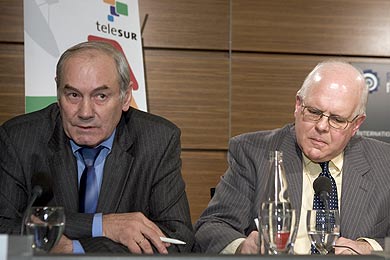
    General Leonid Ivashov (left) at the Axis for Peace Conference 2005 in Brussels, with Webster Tarpley

    As the current international situation shows, terrorism emerges where contradiction aggravate, where there is a change of social relations or a change of regime, where there is political, economic or social instability, where there is moral decadence, where cynicism and nihilism triumph, where vice is legalized and where crime spreads.

    It is globalization what creates the conditions for the emergence of these extremely dangerous phenomena. It is in this context that the new world geo-strategic map is being designed, that the resources of the planet are being re-distributed, that borders are disappearing, that international law is being torn into pieces, that cultural identities are being erased, that spiritual life becomes impoverished...

    The analysis of the essence of the globalization process, the military and political doctrines of the United States and other countries, shows that terrorism contributes to a world dominance and the submissiveness of states to a global oligarchy. This means that terrorism is not something independent of world politics but simply an instrument, a means to install a unipolar world with a sole world headquarters, a pretext to erase national borders and to establish the rule of a new world elite. It is precisely this elite that constitutes the key element of world terrorism, its ideologist and its “godfather”. The main target of the world elite is the historical, cultural, traditional and natural reality; the existing system of relations among states; the world national and state order of human civilization and national identity.

    Today’s international terrorism is a phenomenon that combines the use of terror by state and non-state political structures as a means to attain their political objectives through people’s intimidation, psychological and social destabilization, the elimination of resistance inside power organizations and the creation of appropriate conditions for the manipulation of the countries’ policies and the behavior of people.

    Terrorism is the weapon used in a new type of war. At the same time, international terrorism, in complicity with the media, becomes the manager of global processes. It is precisely the symbiosis between media and terror, which allows modifying international politics and the exiting reality.

    In this context, if we analyze what happened on September 11, 2001, in the United States, we can arrive at the following conclusions: 1. The organizers of those attacks were the political and business circles interested in destabilizing the world order and who had the means necessary to finance the operation. The political conception of this action matured there where tensions emerged in the administration of financial and other types of resources. We have to look for the reasons of the attacks in the coincidence of interests of the big capital at global and transnational levels, in the circles that were not satisfied with the rhythm of the globalization process or its direction.
    Unlike traditional wars, whose conception is determined by generals and politicians, the oligarchs and politicians submitted to the former were the ones who did it this time.

    2. Only secret services and their current chiefs – or those retired but still having influence inside the state organizations – have the ability to plan, organize and conduct an operation of such magnitude. Generally, secret services create, finance and control extremist organizations. Without the support of secret services, these organizations cannot exist – let alone carry out operations of such magnitude inside countries so well protected. Planning and carrying out an operation on this scale is extremely complex.

    3. Osama bin Laden and “Al Qaeda” cannot be the organizers nor the performers of the September 11 attacks. They do not have the necessary organization, resources or leaders. Thus, a team of professionals had to be created and the Arab kamikazes are just extras to mask the operation.

    The September 11 operation modified the course of events in the world in the direction chosen by transnational mafias and international oligarchs; that is, those who hope to control the planet’s natural resources, the world information network and the financial flows. This operation also favored the US economic and political elite that also seeks world dominance.

    (JPEG)
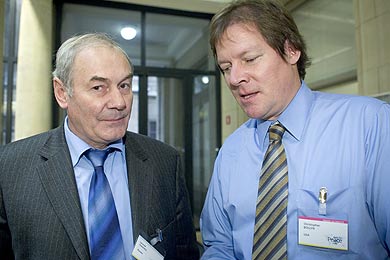
    General Leonid Ivashov with journalist Christopher Bollyn from American Free Press

    The use of the term “international terrorism” has the following goals:
    - Hiding the real objectives of the forces deployed all over the world in the struggle for dominance and control;
    - Turning the people’s demands to a struggle of undefined goals against an invisible enemy;
    - Destroying basic international norms and changing concepts such as: aggression, state terror, dictatorship or movement of national liberation;
    - Depriving peoples of their legitimate right to fight against aggressions and to reject the work of foreign intelligence services;
    - Establishing the principle of renunciation to national interests, transforming objectives in the military field by giving priority to the war on terror, violating the logic of military alliances to the detriment of a joint defense and to favor the anti-terrorist coalition;
    - Solving economic problems through a tough military rule using the war on terror as a pretext. In order to fight in an efficient way against international terrorism it is necessary to take the following steps:
    - To confirm before the UN General Assembly the principles of the UN Charter and international law as principles that all states are obliged to respect;
    - To create a geo-strategic organization (perhaps inspired in the Cooperation Organization of Shanghai comprised of Russia, China, Kazakhstan, Uzbekistan, Kyrgyzstan and Tajikistan) with a set of values different to that of the Atlantists; to design a strategy of development of states, a system of international security, another financial and economic model (which would mean that the world would again rest on two pillars);
    - To associate (under the United Nations) the scientific elites in the design and promotion of the philosophical concepts of the Human Being of the 21st Century.
    - To organize the interaction of all religious denominations in the world, on behalf of the stability of humanity’s development, security and mutual support.

     General Leonid Ivashov
    General Leonid Ivashov is the vice-president of the Academy on geopolitical affairs. He was the chief of the department for General affairs in the Soviet Union’s ministry of Defense, secretary of the Council of defense ministers of the Community of independant states (CIS), chief of the Military cooperation department at the Russian federation’s Ministry of defense and Joint chief of staff of the Russian armies.
    This author's articles

    Beyond Treason

    Beyond Treason

    What you don't know about your government could kill you...
    Department of Defense documents obtained through the Freedom of Information Act expose the horrific underworld of the disposable army mentality and the government funded experimentation upon US citizens conducted without their knowledge or consent. (its been going on for more than 1/2 century)

    UNMASKING SECRET MILITARY PROJECTS:
    Chemical & Biological Exposures
    Radioactive Poisoning
    Mind Control Projects
    Experimental Vaccines (had them- sickest year of my life)
    Gulf War Illness
    Depleted Uranium (DU)

    Is the United States knowingly using a dangerous battlefield weapon banned by the United Nations because of its long-term effects on the local inhabitants and the environment? Explore the illegal worldwide sale and use of one of the deadliest weapons ever invented.

    Beyond the disclosure of black-ops projects spanning the past 6 decades, Beyond Treason also addresses the complex subject of Gulf War Illness. It includes interviews with experts, both civilian and military, who say that the government is hiding the truth from the public and they can prove it.

    I don't doubt a word of it. I also saw what White Phosphorus did to the Iraqi's. Charred the skin right off their flesh. Yes, America did that, and continues murders at an alarming rate every day


    Rumsfeld's Bad Day | bushcommission.org

    Rumsfeld's Bad Day | bushcommission.org

    It just wasn’t a good day for Rummy. He usually speaks only to “safe” audiences of carefully selected military personnel. But on May 4, he made the mistake of speaking to a public audience at the Southern Center of International Studies in Atlanta.

    In a protest organized by World Can’t Wait--Drive out the Bush Regime and other organizations, at least three different protesters were seen on national TV exposing Rumsfeld before being hustled out by cops. One carried a banner denouncing Rumsfeld as a war criminal. Another stood in the audience with her back to Rumsfeld. The Associated Press reported that “the outbursts Rumsfeld confronted on Thursday seemed beyond the usual.”

    Toughest of all for Rumsfeld was the persistent questioning from Ray McGovern. McGovern, a veteran of 27 years as an analyst for the CIA and a member of Veteran Intelligence Professionals for Sanity, knows what he is talking about. McGovern, who also appeared as a witness before the Bush Crimes Commission and as a member of the current Commission campus tour, put a hard line of questioning to Rumsfeld beginning with “ Why did you lie to get us into a war that caused these kind of casualties and was not necessary.” Cops were about to drag off McGovern when Rumfeld waived them off and lamely tried to respond.

    "I'm not in the intelligence business," (no sh*t sherlock) Rumsfeld said about U.S. assertions that now-deposed President Saddam Hussein possessed chemical and biological weapons and was seeking nuclear arms.

    Rumsfeld next tried to blame it all on then-Secretary of Colin Powell, (very lame) in his February 2003 speech before the United Nations detailing U.S. beliefs about Iraqi arms, had "spent weeks and weeks with the Central Intelligence Agency people and prepared a presentation that I know he believed was accurate."

    And Rumsfeld tried to put it on Bush saying that Bush, who made the threat posed by Iraq's weapons his main justification for war, also "spent weeks and weeks with the Central Intelligence people" before making his case to the American people.

    "They gave the world their honest opinion," Rumsfeld added. "It appears that there were no weapons of mass destruction."

    McGovern shot back, "You said you knew where they were," referring to the Iraqi weapons.

    "I did not," Rumsfeld retorted. "I said I knew where suspect sites were."

    "You said you know where they were, near Tikrit, near Baghdad, and north, east, south and west of there. Those are your words," McGovern shot back.

    "I'd just like an honest answer," McGovern added. "We're talking about lies," also mentioning the administration's assertions of prewar ties between Iraq and al Qaeda.

    A week and a half into the war, Rumsfeld was asked on March 30, 2003, on ABC's "This Week with George Stephanopoulos," whether he found it curious that U.S. forces had not yet found weapons of mass destruction.

    "Not at all," Rumsfeld responded, according to a Pentagon transcript of the interview.

    "We know where they are. They're in the area around Tikrit and Baghdad and east, west, south and north somewhat," Rumsfeld stated.

    Rumsfeld on January 20, 2003, said Saddam's government had "large, unaccounted for stockpiles of chemical and biological weapons, including VX, sarin, mustard gas, anthrax, botulism, and possibly smallpox," as well as "an active program to acquire and develop nuclear weapons."

    Later in the day CNN had Ray McGovern on for a nationally broadcast interview. To hear the exchange with Rumsfeld and a Democracy Now interview with Ray McGovern go to: http://www.democracynow.org/article.pl?sid=06/05/05/1432203.

    In this interview, McGovern tells what he received when entering the hall:

    McGovern: You know, it's really interesting that when I walked into the place, I wrangled a ticket very surreptitiously. I was met with this little blurb on Donald Rumsfeld, and as I read it, I had to chuckle. It says, "There's going to be a question-and-answer period, but please adhere to these guidelines. Refrain from using the word 'lie' in relation to the war in Iraq. Do not question the secretary's personal responsibility for torture. And please don't discuss first use of nuclear weapons against Iran. If you violate these guidelines, you'll be immediately removed from the auditorium, flown to an undesignated prison location somewhere in Eastern Europe and tortured. Thank you for your cooperation. The World Can't Wait." A wonderful, wonderful group. Those were the folks that spoke up and tried to brace Donald Rumsfeld with the lies and their charges of him being-- and he is, arguably -- a war criminal. And we shouldn't shy away from saying that."

    For more media response

    Operation Northwoods & 9/11

    When you think about 9/11 Remember this:

    History repeats itself;

    "In the early 1960s, America's top military leaders reportedly drafted plans to kill innocent people and commit acts of terrorism in U.S. cities to create public support for a war against Cuba. Code named Operation Northwoods, the plans reportedly included the possible assassination of Cuban émigrés, sinking boats of Cuban refugees on the high seas, hijacking planes, blowing up a U.S. ship, and even orchestrating violent terrorism in U.S. cities."
    -- ABC News, 5/1/01

    Dear friends,

    The ABC News article quoted above states that Operation Northwoods was approved in writing by the top U.S. military chiefs. These plans even proposed that the U.S. military sacrifice innocent American civilians to create a pretext for war with the justification that "casualty lists in US newspapers would cause a helpful wave of national indignation." Elements within the U.S. government wanted that badly to create a false pretext for war. Does this ring a bell? You can read the full eye-opening article on the ABC website at:

    http://abcnews.go.com/US/story?id=92662&page=1

    The WantToKnow.info team presents this information to inspire a desire in all of us to strengthen democracy and to build a brighter future together. Our website focuses on providing reliable, verifiable facts which are being hidden from public view. By spreading this vital information, each of us can make a difference.

    To access 15 highly revealing pages of declassified U.S. military documents on Operation Northwoods as posted on the National Security Archive of George Washington University, see the link to our Operation Northwoods Information Center immediately below. Instructions are also provided to access all 181 pages of these once top-secret documents on the website of the U.S. National Archives and Records Administration.

    http://www.WantToKnow.info/010501operationnorthwoods

    These astonishing documents were approved in writing by the Joint Chiefs of Staff—the top generals of each branch of the U.S. military. Only rejection by the Kennedy administration kept them from being implemented. They were classified top secret so that the American public would not know how it was being manipulated. A Freedom of Information Act (FOIA) request just a few years ago brought them to light for the first time. The current administration is working hard to keep information like this from reaching the public.

    If you don't have time to read the original documents, do take a look at the key excerpts below. And as you read, remember before the war in Iraq the certainty with which many top government officials stated that there were weapons of mass destruction there. Like on August 26, 2002 when Vice President Cheney declared, "Simply stated, there is no doubt that Saddam Hussein now has weapons of mass destruction" (click here to see this statement on the White House website, about two-thirds down the page). We invite you to then ask yourself, is it beyond comprehension that this same kind of thinking and planning might have led to 9/11?

    Key Excerpts from Operation Northwoods Documents

    Page 1 of File (Memorandum)

    MEMORANDUM FOR THE SECRETARY OF DEFENSE

    Subject: Justification for U.S. Military Intervention in Cuba

    The Joint Chiefs of Staff have considered the attached Memorandum for the Chief of Operations, Cuba Project, which responds to a request of that office for brief but precise description of pretexts which could provide justification for U.S. military intervention in Cuba. It is assumed that a single agency will be given the primary responsibility for developing military and para-military aspects of the basic plan. It is recommended that this responsibility for both overt and covert military operations be assigned the Joint Chiefs of Staff.

    Page 5 of File (page 2 of Joint Chiefs report)

    World opinion, and the United Nations forum should be favorably affected by developing the international image of the Cuban government as rash and irresponsible, and as an alarming and unpredictable threat to the peace of the Western Hemisphere.

    Page 10-11 of File (page 7-8 of Joint Chiefs report)

    A series of well coordinated incidents will be planned to take place in and around Guantanamo to give genuine appearance of being done by hostile Cuban forces.

    (1) Start rumors (many). Use clandestine radio.
    (2) Land friendly Cubans in uniform “over-the-fence” to stage attack on base.
    (3) Capture Cuban (friendly) saboteurs inside the base.
    (4) Start riots near the base main gate (friendly Cubans).
    (5) Blow up ammunition inside the base: start fires.
    (6) Burn aircraft on air base (sabotage).
    (7) Lob mortar shells from outside of base into base.
    (8) Capture assault teams approaching from the sea or vicinity of Guantanamo City.
    (9) Capture militia group which storms base.
    (10) Sabotage ship in harbor; large fires – naphthalene.
    (11) Sink ship near harbor entrance. Conduct funerals for mock-victims.

    We could blow up a U.S. ship in Guantanamo Bay and blame Cuba. Casualty lists in US newspapers would cause a helpful wave of national indignation. We could develop a Communist Cuban terror campaign in the Miami area, in other Florida cities and even in Washington.

    Page 12 of File (page 9 of Joint Chiefs report)

    Use of [Soviet] MIG type aircraft by US pilots could provide additional provocation. Attacks on surface shipping and destruction of US military drone aircraft by MIG type planes would be useful as complementary actions. Reasonable copies of the MIG could be produced from US resources in about three months.

    Page 13 of File
    (page 10 of Joint Chiefs report)

    It is possible to create an incident which will demonstrate convincingly that a Cuban aircraft has attacked and shot down a chartered civil airliner enroute from the United States. The destination would be chosen only to cause the flight plan to cross Cuba. The passengers could be a group of college students off on a holiday.

    An aircraft at Eglin AFB would be painted and numbered as an exact duplicate for a civil registered aircraft belonging to a CIA proprietary organization in the Miami area. At the designated time the duplicate would be substituted for the actual civil aircraft and would be loaded with selected passengers, all boarded under carefully prepared aliases. The actual aircraft would be converted to a drone. [The fact that the military had the capability to fly unmanned drone airplanes back in the 1960s was kept top secret for decades. - ed.]

    The drone aircraft and the actual aircraft will be scheduled to allow a rendezvous south of Florida. From the rendezvous point the passenger-carrying aircraft will descend to minimum altitude and go directly into an auxiliary field at Eglin AFB where arrangements will have been made to evacuate the passengers and return the aircraft to its original status. The drone aircraft meanwhile will continue to fly the filed flight plan. When over Cuba the drone will be transmitting on the international distress frequency a “MAY DAY” message stating he is under attack by Cuban MIG aircraft. The transmission will be interrupted by destruction of the aircraft which will be triggered by radio signal.

    What We Can Do

    Remember that government and military leaders think of this like a chess game. Sometimes you have to sacrifice your own pieces in order to win the game. Zbigniew Brzezinski, former U.S. National Security Advisor and co-founder of the Trilateral Commission, titled his 1997 book The Grand Chessboard: American Primacy and Its Geostrategic Imperatives. In this seminal book on American foreign policy, Brzezinksi states that because of popular resistance to U.S. military expansionism, his ambitious strategy for "American global primacy" can’t be implemented "except in the circumstance of a truly massive and widely perceived direct external threat." (The Grand Chessboard page 211).


    Consider also that in September 2000, a think-tank named Project for the New American Century (PNAC) published a blueprint for maintaining global U.S. preeminence and shaping the international security order in line with American interests. Written before the 2000 Presidential election, this revealing report was commissioned by future Vice President Cheney, Defense Secretary Rumsfeld, Deputy Defense Secretary Wolfowitz, and Florida Governor Jeb Bush. The report shows that the Bush administration intended to take military control of Persian Gulf oil whether or not Saddam Hussein was in power. [See article in Sunday Herald, 9/7/02 or click here to download the report--Rebuilding America's Defenses]

    Considering the above information, is it beyond comprehension that tactics similar to Operation Northwoods might have been used in relation to the 9/11 attacks in order to create "a truly massive and widely perceived direct external threat?" Could 9/11 have been the pretext upon which to build a War on Terror in order to "maintain global US preeminence?" Might the 9/11 attacks have been allowed to happen, or even facilitated and manipulated by elements of the U.S. government and military?

    We invite you to explore a two-page summary of easily verifiable facts with links direct to major media sources which suggest a major 9/11 cover-up at http://www.WantToKnow.info/9-11cover-up. The riveting, highly popular documentary "Loose Change" (available free on Google Video) also explores the above facts and much more. For additional empowering information on these and other reliable resources on the 9/11 cover-up, visit our 9/11 Information Center. We draw no firm conclusions in the resources we provide. We present reliable, easily verifiable facts and information with minimum interpretation, inviting you to draw your own conclusions.

    We invite you now to join in making a difference in our world. By spreading this information far and wide, we can help many others to wake up to what is happening.

    Together, we can build the critical mass necessary to strengthen democracy, and to change this world for the better. We thank you for caring enough to explore this vital information. May we find empowering ways to work together to build a brighter future for us all.

    With best wishes,
    Fred Burks for the WantToKnow.info Team
    Former language interpreter for Presidents Bush and Clinton

    Photobucket