16.4.06

NATIONAL JOURNAL: Cheney Authorized Leak Of CIA Report, Libby Says (04/14/2006)

NATIONAL JOURNAL: Cheney Authorized Leak Of CIA Report, Libby Says (04/14/2006)

Those words came out of my mouth since day 1. Cheney has authorized an awful lot of nasty things that should this country survive, leave him with his true and evil colors showing for generations to come...if we have generations to come. The Bush regime is working on that too, since you can't save your ass and your face at the same time.

Vice President Dick Cheney directed his then-chief of staff, I. Lewis "Scooter" Libby, on July 12, 2003 to leak to the media portions of a then-highly classified CIA report that Cheney hoped would undermine the credibility of former Ambassador Joseph C. Wilson, a critic of the Bush administration's Iraq policy, according to Libby's grand jury testimony in the CIA leak case and sources who have read the classified report.

The March 2002 intelligence report was a debriefing of Wilson by the CIA's Directorate of Operations after Wilson returned from a CIA-sponsored mission to Niger to investigate claims, later proved to be unfounded, that Saddam Hussein had attempted to procure uranium from the African nation, according to government records.

There is a growing body of information showing that at the time Plame was outed the vice president was deeply involved in the effort to undermine her husband. Hello? Thanks for getting a clue to the obvious.

The debriefing report made no mention of Wilson's wife, Valerie Plame, then a covert CIA officer, or any role she may have played in her husband's selection by the CIA to go to Niger, according to two people who have read the report.

The previously unreported grand jury testimony is significant because only hours after Cheney reportedly instructed Libby to disclose information from the CIA report, Libby divulged to then-New York Times reporter Judith Miller and Time magazine correspondent Matthew Cooper that Plame was a CIA officer, and that she been involved in selecting her husband for the Niger mission.

Both Libby and Cheney have repeatedly insisted that the vice president never encouraged, directed, or authorized Libby to disclose Plame's identity. In a court filing on April 12, Libby's attorneys reiterated: "Consistent with his grand jury testimony, Mr. Libby does not contend that he was instructed to make any disclosures concerning Ms. Wilson [Plame] by President Bush, Vice President Cheney, or anyone else."

But the disclosure that Cheney instructed Libby to leak portions of a classified CIA report on Joseph Wilson adds to a growing body of information showing that at the time Plame was outed as a covert CIA officer the vice president was deeply involved in the White House effort to undermine her husband.

A spokesman for the vice president declined to comment.

Click here for previous coverage of pre-war intelligence
and the CIA leak investigation

On April 5, the special prosecutor in the CIA leak case, Patrick J. Fitzgerald, asserted in a court filing that Joseph Wilson's July 6, 2003 op-ed piece in The New York Times criticizing the Bush administration's Iraq policies "was viewed in the office of Vice President as a direct attack on the credibility of the Vice President (and the President) on a matter of signal importance: the rationale for the war in Iraq."

Moreover, on July 12, 2003, the same day that Libby spoke to both Cooper and Miller, Libby and Cheney traveled aboard Air Force Two for the dedication of a new aircraft carrier in Norfolk, Va. During the flight either to or from Norfolk, Cheney, Libby, and Cathie Martin, then-assistant to the vice president for public affairs, discussed how they might rebut Wilson's charges and discredit him, according to federal court records, and interviews with people with first-hand knowledge of accounts that all three provided to federal investigators.

It has long been known that Cheney was among the first people in the government to tell Libby that Plame worked for the CIA. The federal indictment of Libby -- who has been charged with five counts of obstruction of justice, perjury, and making false statements to federal investigators in the CIA leak case -- states: "On or about June 12, 2003, Libby was advised by the Vice President of the United States that Wilson's wife worked at the Central Intelligence Agency in the Counterproliferation Division. Libby understood that the Vice President had learned this information from the CIA."

Fitzgerald asserted that just days before Libby divulged Plame's identity to Miller and Cooper on July 12, "Vice President Cheney, [Libby's] immediate superior, expressed concerns to [Libby] regarding whether Mr. Wilson's trip was legitimate or whether it was a junket set up by Mr. Wilson's wife." Although contained in a public court filing, this second conversation between Cheney and Libby had gone unreported.

The new disclosure about the CIA report further raises questions about the vice president's role in directly authorizing the leak of classified information outside the formal declassification process. Last week it was reported that Libby also testified to the grand jury that Cheney told him that as part of the effort to rebut Wilson's criticism, President Bush had authorized the leaking of portions of a then-classified National Intelligence Estimate concerning purported attempts by Iraq to develop nuclear weapons.

The Bush administration has asserted that presidents have the constitutional right to declassify information. Although vice presidents haven't shared such authority, President Bush issued an executive order in March 2003 allowing Cheney to share such authority with him. According to Fitzgerald's April 5 filing, Libby has also testified that in July 2003, then-Counsel to the Vice President David Addington "opined that Presidential authorization to publicly disclose a document amount to a declassification of the document."

Jeffrey Smith, a former general counsel for the CIA, said in an interview, however, that while there are executive orders that apparently allow the vice president "on his own to determine what to declassify and to whom," that authority should "not exempt him or anyone from exercising prudence or good judgment" in doing so. "You would want the president or the vice president to seek the views of the CIA or any other intelligence agencies... to make sure that there is no potential disclosing an intelligence source" or some other sensitive information.

Criticizing the decision to leak portions of the NIE, Rep. Jane Harman, D-Calif., the ranking member on the House Intelligence Committee, said last week: "Leaking classified information to the press when you want to get your side out or silence your critics is not appropriate. If I had leaked the information, I'd be in jail. Why should the president be above the law? I am stunned."

In his grand jury testimony, according to Fitzgerald's filing, Libby portrayed himself as a reluctant subordinate in July 2003 who took orders from higher ups. Libby "testified that he at first advised the Vice President that he could not have this conversation with [Judith] Miller because of the classified nature of the NIE," said the special counsel's filing. "[Libby] testified that the Vice President later advised him that the President had authorized [Libby] to disclose the relevant portions of the NIE." It was during this time that Libby says he spoke to Addington on the matter.

Steve Aftergood, a senior research analyst with the Federation of American Scientists, who tracks government secrecy and classification issues, said that Libby "presents himself in this instance and others as being very scrupulous in adhering to the rules. He is not someone carried on by the rush of events. If you take his account before the grand jury on face value, he is cautious and deliberative in his behavior.

"That is almost the exact opposite as to how he behaves when it comes to disclosing Plame's identity," Aftergood said. "All of a sudden he doesn't play within the rules. He doesn't seek authorization. If you believe his account, he almost acts capriciously. You have to ask yourself why his behavior changes so dramatically, if he is telling the truth that this was not authorized and that he did not talk to higher-ups."

Libby has insisted that the vice president never authorized or told him to discuss Plame's identity. Although Libby discussed Plame with Miller and Cooper on July 12, 2003 -- the same day he says he was authorized by Cheney to leak portions of the NIE and the CIA report -- Libby insists the two actions are unrelated.

The new disclosure also raises the question whether President Bush or his aides knew that Cheney may have been deciding on his own to authorize the leaking of classified information. Senior government officials said that top Bush aides -- including then-deputy National Security Adviser Stephen J. Hadley and White House Communications Director Dan Bartlett -- were not aware that Cheney had authorized the disclosure of the CIA report on Wilson's Niger mission. These officials raised the possibility that Bush himself was unaware at the time of Cheney's action.

Regarding the release of Plame's name and CIA employment, a senior administration official said that even if Cheney did not directly authorize Libby to leak the information to the press, the vice president might have set a climate in which his aides viewed it as routine to release classified information whenever it served their purposes.

The administration was interested in discrediting Wilson because the former ambassador asserted in his op-ed piece that he found no evidence in Niger to substantiate Bush administration claims that Saddam had attempted to purchase uranium from that country. Wilson alleged that the administration had misrepresented intelligence by making that claim in its case to go to war with Iraq. Six days after the Times published Wilson's piece, Libby leaked Plame's identity to Miller and Cooper.

Cheney and other Bush administration officials also believed that the CIA debriefing report might undermine Wilson's claims because it showed that Wilson's Niger probe was inconclusive on the uranium questions. Wilson was restricted on the persons he was able to interview in Niger, and he was denied some intelligence information before undertaking the trip.

In reportedly directing Libby to disclose portions of the March 2002 CIA report on Wilson's mission, Cheney apparently kept in the dark a number of administration officials who were working to declassify that very same document.

According to Fitzgerald's recent filing, Libby "testified that on July 12, 2003, he was specifically directed by the Vice President to speak to the press in the place of Cathie Martin (then the communications person for the Vice President) regarding the NIE and Wilson. [Libby] was instructed... to [also] provide information contained in a document [he] understood to be the cable authored by Mr. Wilson. During the conversations that followed on July 12 [Libby] discussed Ms. Wilson's [CIA] employment with both Matthew Cooper (for the first time) and Judith Miller (for the third time)."

The purported Wilson cable refers to the classified CIA debriefing of Wilson, according to sources who have read the document. Wilson never himself authored a cable on his Niger mission. Rather, the CIA Directorate of Operations, which sent Wilson to Niger in February 2002, produced a March 8, 2002 report based on Wilson's debriefing by intelligence officers. The report did not name Wilson, or even describe him as a former ambassador, but rather as a "contact with excellent access who does not have an established reporting record" to protect the-then covert nature of the trip.

The report was then "widely distributed in routine channels," according to a 2004 Senate Intelligence Committee report on the CIA's prewar intelligence on Iraq. It is unclear whether Cheney or his office received the report at the time it was distributed, or sometime later.

But two government officials with first-hand knowledge of events said during the summer of 2003, Libby and other White House officials sought any reports and other classified information regarding Wilson's Niger trip, and it was provided at that time.

A relatively small amount of information derived from the March 2002 report was revealed on July 11, 2003, when then-CIA Director George Tenet released a statement regarding Wilson's trip to Niger in which he disclosed some aspects of the debriefing described in the document. But other portions remained highly classified at the time that Cheney directed Libby to leak portions of the report, two senior government officials said in interviews. These officials say the White House abandoned its attempt to declassify all or part of the March 2002 report when Tenet released his statement.

The federal indictment of Libby states: "On or about June 9, 2003, a number of classified documents were faxed to the Office of the Vice President to the personal attention of Libby and another person in the Office of the Vice President. The faxed documents, which were marked as classified, discussed, among other things, Wilson and his trip to Niger, but did not mention Wilson by name. After receiving these documents, Libby and one or more persons in the Office of the Vice President handwrote the names 'Wilson' and 'Joe Wilson' on the documents."

It is unclear if one of the documents in question, or the one with Wilson's name handwritten on it by someone in the Vice President's office, was the March 2002 CIA report, but the fact that it did not mention Wilson by name suggests that it possibly was indeed the one with the handwriting.

Cheney, Libby, and others wanted to leak and declassify portions of the report because they believed that it would undercut the perception that Wilson's mission had disproved the allegations definitively that Iraq had attempted to procure uranium from Niger, two senior government officials said in interviews.

Among other things, Wilson had agreed only to interview former Nigerien officials, instead of current ones, so as not to step on the toes of the State Department or its then-ambassador to Niger, and he was disadvantaged in his inquiries, the two senior government officials said.

In an interview, Wilson said it was unnecessary to interview current Nigerien officials because the then-U.S. ambassador was conducting her own inquiry, and a decision was made for him to speak to former Nigerien officials while the ambassador made her inquiries of the current government.

"When I arrived in Niger, I spoke to the ambassador who thought that she had already debunked the allegations with current Niger officials," Wilson said. "We agreed then that I would speak to former government officials, who I knew better than she did because I worked with them while I was on the NSC staff at the White House, and thereafter. So that was the division of labor."

Wilson also said that the ambassador told her that a "four-star Marine general had also already talked to current officials, and that he too had concluded and reported that he believed there was nothing to the allegations."

-- National Journal correspondent Shane Harris also contributed to this report.

US Strike on Iran: Fallout Around the World Would Be Grim

US Strike on Iran: Fallout Around the World Would Be Grim

by Tim Harper

WASHINGTON—On the ground, more terror.


It would be Iran's Pearl Harbor and it will be the beginning of a war, not the end of a war. It will set back American strategic interests for a generation.

Joseph Cirincione, Carnegie Endowment for International Peace
Poison-laced missiles raining down on U.S. troops in Iraq or Afghanistan, the downing of a U.S. passenger airliner, suicide bombers in major cities, perhaps unleashing their deadly payload in a shopping mall food court. It could be 9/11 all over again. Or worse.

On the political front, more anti-Americanism.

Renewed venom aimed at Washington from European capitals, greater distrust from China and Russia, outright hatred in the Arab and Muslim world. Oil prices spiralling out of control, a global recession at hand.

In Iran, a galvanizing of a splintered nation. An end to hopes for political reform, a rally-around-the-leader phenomenon common among the victimized, an ability to rebuild a nuclear program in two to four years.

These are the potential costs of a U.S. military strike in Iran.

"It would be Iran's Pearl Harbor and it will be the beginning of a war, not the end of a war. It will set back American strategic interests for a generation," says Joseph Cirincione, the director for non-proliferation at the Carnegie Endowment for International Peace.

"The war will take place at a time and location of Iran's choosing. It will make Iraq look like a preliminary bout."

But the cost of inaction could be even higher: a defiant nation with an apparently unstable leadership steeped in hatred for Americans in the heart of the Middle East with nuclear capabilities.

With Tehran ignoring both threats and cajoling from the international community and declaring itself — prematurely — part of the world's "nuclear club" this week, talk of the Washington stick moved to the forefront, while the carrot, now discredited, was pushed off center stage.

While the week began with the White House trying to tamp down speculation about military strikes in Iran, reported by The Washington Post and by journalist Seymour Hersh in The New Yorker, it was becoming clear the Bush administration was growing impatient with a diplomatic effort that is not working with Tehran.

It may have also welcomed talk of potential military strikes, even if it would be extremely reluctant to use them, simply to remind some recalcitrant United Nations members such as China and Russia that diplomacy does have an end date.

The bluntest assessment of diplomatic success came from Karl Rove, U.S. President George W. Bush's political adviser and deputy chief of staff, who told a Houston audience Iranian President Mahmoud Ahmadinejad was "not a rational human being."

"We are engaged in a diplomatic process with our European partners and the United Nations to keep (Iran) from developing such a weapon," Rove said. "It's going to be tough because they are led by ideologues who have a weird sense of history."

Ahmadinejad announced this week that Iran had taken its nuclear enrichment program to new levels. Before he did so, he dismissed any influence of the United Nations, according to state media. "They know they cannot do a damned thing," he said.

The Iranian government has stated it will construct 3,000 centrifuges at a facility in Natanz and would eventually expand that to 54,000 centrifuges, which spin uranium into fuel rich enough to produce atom bombs. Estimates of their capability date range from 2010 to 2020.

Bush has been clear he wants to stop Tehran from acquiring even the knowledge needed to build nuclear weapons, and last month he vowed U.S. military might could be used to protect staunch allies such as Israel.

But, earlier this week, Bush called reports of potential military strikes on Iran "wild speculation." British Foreign Minister Jack Straw said the stories were "completely nuts."

U.S. Defense Secretary Donald Rumsfeld weighed in, saying he wouldn't address things from "fantasy land," but then added: "The last thing I'm going to do is to start telling you or anyone else in the press or the world at what point we refresh a plan or don't refresh a plan, and why. It just isn't useful."

U.S. Secretary of State Condoleezza Rice sternly called for action at the UN, but didn't say what it could be, leaving her spokesman sputtering about "re-underlining" the call for Iran to suspend its enrichment program and vowing this time the Security Council will do more than just release a statement.

"This is not a question of Iran's right to civil nuclear power," Rice said. "This is a question that the world does not believe that Iran should have the capability and the technology that could lead to a nuclear weapon.

"When the Security Council reconvenes, it will be time for action."

The timing of military strikes is now being openly debated in Washington.

Cirincione says he believes there will be secret strikes announced by Bush after they happen. But first, he says, Bush should be expected to go to the U.S. Congress for authorization before mid-term elections in November, while Republicans still control the House of Representatives and the Senate.

Approval before the elections, the strike after the elections, because the almost certain spike in U.S. gas prices following such action will blunt any rally-round-the-flag effect at election time, he says. John Pike, a military analyst at globalsecurity.org, predicts strikes in the summer of 2007, safely away from the presidential election the next year. He argues, as many do, that Bush already has congressional approval and needs not go back to lawmakers. "It will be a surprise," he says. "There's nothing like dropping bombs on evil-doers to give Republicans some political updraft."

Pike argues that, despite all the breast-beating in Congress about misuse of a resolution that got the country into war in Iraq and all the sound and fury about clandestine surveillance in this country, nothing has been done to strip Bush of any power when it comes to war. "He will be looking at atomic ayatollahs. There will be some real downsides (to military action) and there will be efforts to redouble diplomatic moves, but in Tehran, the U.S. is equated with Satan.

"What kind of diplomatic solution do they believe they can get from Satan?"

Other analysts have been blunt in their assessment of the cost to the United States.

"The most dangerous delusion is that a conflict would be either small or quick," says Richard Haass, the president of the non-partisan Council on Foreign Relations.

Haass, who until July 2003 was a principal adviser to former secretary of state Colin Powell, says destroying Iran's nuclear capacity would require numerous cruise missiles and aircraft.

"Iran would be sure to retaliate, using terrorist groups such as Hezbollah and Hamas and attacking U.S. and British forces and interests in Iraq and Afghanistan," he said in a written analysis this week. "This would require the U.S. to respond militarily against a larger set of targets inside Iran. What would begin as a limited strike would not remain limited for long."

Haass also warned that such a strike would likely push oil prices above $100 (U.S.) per barrel, setting off an economic chain reaction that could lead to global recession. He predicts a certain increase in anti-Americanism in Europe, further rage against the U.S. in the Arab and Muslim world, and a questioning of U.S. ties in Russia and China.

Ken Pollack of the more liberal Brookings Institution argues for sanctions restricting investment in Tehran.

"The world community should force Iranians to have an internal debate — do they want their nuclear program more than a healthy economy?" he told a recent forum.

But Pollack adds a sobering point. If the administration truly believes it cannot live in a world in which Iran has nuclear weapons, the military option may be the only way to prevent that.

But it would be seen as an unprovoked attack on a country that has attacked no one. It would be likened to Osama bin Laden's attack on the U.S., Pollack said, reminding his audience how the United States responded to that.

No, Our leaders set up the attack on america on 9/11 to forge their segue into this war, and since the heat getting hotter to bring the Bush regime down, what do they have to lose by doing something as stupid as attack Iran?
They haven't done anything FOR america but take away from the US for their investments in foreign interests.

E-Mails Link Abramoff, Bush Official

E-Mails Link Abramoff, Bush Official

E-Mails Link Abramoff, Bush Official
By Mark Sherman
The Associated Press

Saturday 15 April 2006

A batch of 278 e-mails between lobbyist Jack Abramoff and a Bush administration official show a highly inappropriate relationship where gifts and business interests mixed freely and frequently, federal prosecutors said Friday. Ah yes, George, Remember "wiretapping"...it came back and bit you in the a** hahahahahahahaha

The prosecutors hope to use the e-mails in the criminal case against David Safavian, who is accused of lying and obstruction of justice in connection with investigations of an Abramoff-sponsored golf outing to Scotland in August 2002.

The e-mails show that Abramoff and Safavian, then chief of staff at the General Services Administration, were in frequent contact, played golf often and traded workplace gossip. Abramoff showered Safavian with offers of meals, invitations to parties as well as the trip to the fabled St. Andrew's golf course in Scotland.

One message from Abramoff, sent July 23, 2002, asks Safavian, "golf Friday? golf Sunday? golf Monday? golf, golf, golf!!"

At the same time, Abramoff is peppering Safavian with questions and requests for his help on a variety of projects, including obtaining parcels of federal land that were managed by GSA for Abramoff's charitable groups.

"The e-mails demonstrate that Mr. Safavian's relationship with Mr. Abramoff was highly inappropriate," prosecutors wrote in a court filing accompanying the e-mails.

Prosecutors and Safavian's attorneys are engaged in a legal fight over how much of this material should be shown to the jury during Safavian's upcoming trial, which is scheduled to begin May 22.

Barbara Van Gelder, a lawyer for Safavian, described the court filing as "a press release that allows the government to place inadmissible hearsay documents into the public record right before trial."

Van Gelder said that while Abramoff offered Safavian meals, trips and sports tickets, the "evidence shows that Mr. Safavian either declined the offers or paid for the expense with his own money. There is no conspiracy. There is no agreement. This is the government's attempt to inflate a flat case with hot air."

Sometimes Safavian responds to Abramoff with an invitation of his own, insisting in one instance that they play golf at Safavian's club in Springfield, Va. On another occasion, just after the Scotland trip, Safavian told Abramoff that he recommended the lobbyist to an architectural and engineering firm that wanted to become eligible for federal contracts. He titled his e-mail, "Client Development."

When Abramoff invited Safavian and his wife to have their anniversary dinner at Abramoff's Signatures restaurant in downtown Washington, Safavian declined, saying he was preparing veal cutlets a la suisse at home.

Van Gelder has said that the government has been trying to pressure Safavian to provide information about Abramoff and others who are part of the wide-ranging investigation of lobbying fraud and public corruption.

Abramoff is cooperating with federal investigators. He pleaded guilty in January to federal charges of conspiracy, tax evasion and mail fraud.

The e-mails also reveal that in early 2002 Safavian thought about leaving his congressional staff job for Abramoff's firm, Greenberg Traurig. Abramoff strongly supported that idea, but Safavian apparently never received an offer, according to the e-mails.

"Just spoke with Fred. He asked what I am going to do. I told him I was leaning towards GSA, but was waiting to hear back from GT. Unfortunately he didn't talk any numbers," Safavian wrote Abramoff on April 30.

An hour later, Abramoff replied: "This is crap. Should I call Fred right now? you should get a ... offer!!! Idiots over here!!"

Instead, Safavian moved from Congress to the General Services Administration.

The two men also looked for opportunities to get Abramoff together with GSA Administrator Stephen A. Perry. Safavian tells Abramoff the GSA July 4 party would be a good place to meet Perry. Abramoff at one point suggests bringing Perry along to Scotland. Perry was not part of that trip.

15.4.06

US threats against Iran-the specter of nuclear barbarism

US threats against Iran-the specter of nuclear barbarism

The revelation that the United States government has conducted advanced planning and preparation for a bombing campaign against Iran that includes the possible use of nuclear weapons represents the most serious threat posed in an increasingly unstable international situation.

US imperialism has embarked upon a trajectory that will, if not stopped, lead to a world historic catastrophe that will make World War II pale by comparison.

That such an act could even be contemplated by the Bush White House should stun and horrify all those who are concerned with the fate of the world and the future of humanity. Little more than six decades after US imperialism carried out the first atomic bombings against Hiroshima and Nagasaki—inflicting horrors that generations since have vowed must never be repeated—Washington is actively considering the use of such terrible weapons once again, this time without provocation or even credible proof of a future threat. Such an act would have the effect of criminalizing America as a country and a society.

These plans are not only real, but are already being acted upon, as was confirmed by Seymour Hersh in an article published in this week’s New Yorker magazine as well as by the Washington Post. The preparations include the deployment of special operations troops inside Iran to spot targets and the staging of air exercises in the skies over the Arabian Sea, simulating strikes with nuclear tipped missiles against Iranian nuclear facilities.

The threat of war has only intensified since the publication of these articles, with the Iranian government’s announcement Tuesday that it has succeeded in enriching uranium for its nuclear power program. Teheran once again insisted that this program is meant solely for peaceful uses, and experts confirmed that the development still left Iran far from being able to produce the weapons-grade enriched uranium needed for a nuclear weapon.

There is undoubtedly a strong element of recklessness in the actions taken by the government in Teheran, which is pursuing shortsighted political aims of its own in the nuclear confrontation, utilizing the nationalist resentment of a large section of the Iranian people towards US bullying as a means of diverting social and political tensions within Iran. The actions of the bourgeois factions that control the Iranian government have done nothing to defend the Iranian people from the threat of war. Indeed, they have played into the hands of the right-wing militaristic clique that controls the White House.

Domestic political calculations play a prominent role in the new US buildup to war. The collapse of popular support for Bush’s policies—itself a manifestation of a deep-rooted social crisis in the US—has encouraged the administration to embark on another campaign of military aggression as a means of stampeding public opinion and suppressing opposition.

Predictably, the Bush administration responded to the latest announcement from Teheran by ratcheting up its bellicose threats. Secretary of State Condoleezza Rice said Wednesday that the United Nations Security Council must take “strong steps” against Iran to “maintain the credibility of the international community.” She added, “We can’t let this continue.”

Defense Secretary Donald Rumsfeld described Iran as “a country... that supports terrorists.” He continued: “It’s a country that has indicated an interest in having weapons of mass destruction.”

The administration is following a virtually identical script as that used in the run-up to the war on Iraq, with dark and unsubstantiated warnings of a supposedly imminent threat from “weapons of mass destruction” that can be stopped only through US-initiated “regime change.” Once again, Washington is dismissing United Nations monitoring of the Iranian nuclear program as useless, and there can be little doubt that, given the almost certain refusal of Russia, China and perhaps other members of the Security Council to back military action, the Bush White House will again declare the UN irrelevant and embark on its own unilateral action.

Speaking before an audience at the Johns Hopkins University School of Advanced International Studies, Bush repeated his bellicose 2002 denunciation of Iran as constituting—along with North Korea and the now US-occupied Iraq—part of an “axis of evil.”

Bush declared that his strategy in relation to Iran was based upon a “doctrine of prevention.” In the language of international statecraft, a preventive war is a war of aggression launched with the aim of preventing a perceived rival from gaining power or achieving a strategic advantage in the future. Under the precedent established by the Nuremberg trials of the German Nazi leadership, it constitutes a war crime.

The World Socialist Web Site has drawn attention to the stark parallels that exist between the policies pursued by the US administration and the methods employed by the leaders of Germany’s Third Reich in the 1930s and 1940s. The utter contempt for international law, the launching of military aggression on the basis of bogus pretexts, the use of overwhelming force against relatively powerless victims are common to both regimes. Some of our readers may have dismissed such comparisons as exaggerated. With the latest revelations concerning US war plans against Iran, such complacency is no longer tenable.

There is a powerful element of recklessness and even insanity in the US threat to use nuclear weapons—for the first time anywhere on the planet since the end of the Second World War—for the supposed purpose of preventing Iran from gaining the technology that could be used to produce nuclear weapons.

Drive for oil and strategic advantage

Underlying this apparent madness, however, is a definite policy being pursued by US imperialism. As in Iraq, the primary motive behind the war threats against Iran is not weapons of mass destruction, but oil. The Iranian nuclear program is not, in reality, seen by Washington as a huge threat. As in Iraq, WMD serves as a casus belli for military action in pursuit of other objectives.

We do not support the Iranian government’s efforts to obtain nuclear weapons, on the principled grounds that they in no way advance the struggle of workers in Iran or elsewhere in the region. However, even if Iran were to acquire a nuclear weapon, it would have no major military significance, given the overwhelming force in the hands of the US.

Iran is, after all, surrounded by countries with such weapons—Russia, Israel, Pakistan, India—some of them having obtained these weapons with the open support of Washington. Had the US-backed dictatorship of the Shah not been overthrown, the nuclear program that it began, with the direct support of people like Cheney and Rumsfeld, would have undoubtedly long since produced bombs.

The American administration is merely exploiting popular ignorance of the situation and a compliant media to create a smokescreen behind which it is pursuing definite interests. Iran possesses the world’s second-largest natural gas reserves and the fourth largest oil reserves, which are expected to produce for some decades after Saudi Arabia’s oil runs dry. Moreover, Washington is confronted with the political fact that Iran stands to emerge as the principal beneficiary of the US intervention in Iraq, threatening to thwart the US attempt to establish unchallenged hegemony over the Persian Gulf and the region’s strategic energy resources.

An even greater threat to US interests is seen in Iran’s growing ties with Russia, China and Europe. Washington has no intention of allowing its major economic rivals to reap a strategic advantage from its decades-long policy of economic sanctions against Iran. In particular, the ties between Iran and Russia are seen as an impediment to the US drive to control the enormous untapped oil and gas reserves in the former Soviet republics of Central Asia.

In the final analysis, the threat of a war of aggression against Iran and the use of nuclear weapons express the historic crisis of American and world capitalism, and the accelerating disequilibrium within the entire capitalist nation-state system. This disequilibrium—and its malevolent product, the danger of a new world war—has been exacerbated both by the collapse of the Soviet Union and the relative decline of US capitalism’s position within the world economy.

Within America’s ruling oligarchy, these parallel developments have fostered a consensus strategy of exploiting US imperialism’s military superiority for the purpose of reorganizing the world economy in the interests of US-based banks and transnational corporations. This means the seizure of strategic positions and resources—as in the Persian Gulf—and the use of militarism and war to preclude the emergence of any rival, even of a regional character, that would challenge America’s bid for global hegemony.

Bush’s dismissal of reported plans for the use of nuclear weapons notwithstanding, there is ample evidence that within the US political establishment what was once unthinkable is now seen as a viable option. Published in the current issue of Foreign Affairs, which reflects the views of the US foreign policy establishment, is an article entitled “The Rise of US Nuclear Primacy.” This article makes the case for a winnable nuclear war based on technological advances in US weapons systems and the deterioration of the former Soviet Union’s nuclear arsenal.

“Today, for the first time in almost 50 years, the United States stands on the verge of attaining nuclear primacy,” the article states. “It will probably soon be possible for the United States to destroy the long-range nuclear arsenals of Russia or China with a first strike.”

A nuclear strike against Iran, which borders Russia, would represent a first step in testing out this strategy. It would serve not merely to devastate Iran and inflict massive civilian casualties on that country, but to threaten Russia, China and any other power that might stand in the way of American imperialist aims.

The US is moving in a direction that leads inexorably toward a wider and catastrophic war that would claim the lives of hundreds of millions. As for the next act of US military aggression, the question is not if, but only when.

Iraq has already shown that within the existing US political structure there is no means to stop this threat. On the threat of a war against Iran, the Democratic Party has remained virtually silent.

In his New Yorker article, Hersh quoted one member of the House of Representatives as saying, “There’s no pressure from Congress” against launching a new war.

There has been no call by any section of the Democratic Party leadership for public hearings to consider the political, military, legal and moral implications of reported plans for a war that could involve the use of nuclear weapons. There is no reason to believe that Congress and the Democrats will not be just as complicit in this new criminal act as they were in the invasion and occupation of Iraq.

Symptomatic of the reaction of the erstwhile liberals was the editorial appearing in Tuesday’s edition of the New York Times under the complacent headline, “Military fantasies on Iran.”

“Congress and the public need to force the kind of serious national debate that never really took place before the American invasion of Iraq,” the Times declares, noting that the administration is making threats of “future American military action in language that sometimes recalls statements made before the invasion of Iraq.”

The editorial’s call for a “serious national debate” on a new war of aggression echoes precisely the language used by the Times in the months leading up to the invasion of Iraq. At that time it urged the administration to continue pursuing a pseudo-legal justification for the war, and advocated a “debate” to prepare the public for it. When, however, the White House ordered an invasion without UN sanction, the newspaper supported it anyway.

This latest editorial warns about the possible adverse implications of air strikes against Iran for US troops in Iraq, questions whether such strikes could really “destroy all of Iran’s nuclear facilities,” and describes a war with Iran as “reckless folly.” But the newspaper does not denounce the prospect of unprovoked air attacks and the possible use of nuclear weapons for what they are—war crimes. Clearly, the editors see such things as real possibilities.

Police state measures at home

The implications for American society itself of such an act of war are staggering. Such attacks would undoubtedly provoke retaliation, which would be seized upon by the administration in Washington to mount a dramatic intensification of the “war on terror,” in the form of further military escalation abroad and the elimination of basic democratic rights at home.

The use of nuclear weapons by the US would provoke outrage and horror within the American population, sparking mass opposition. The government would respond with out-and-out repression. The prospect of the American people facing a fascist-military dictatorship as the byproduct of such a military attack is very real.

Posed in the new war threats against Iran is the basic alternative of the present historic epoch: socialism or barbarism. A fight against both this new threat and the ongoing war in Iraq can be waged only through the independent mobilization of American working people, together with workers and oppressed people all over the world. This must assume the form of a political struggle against the American financial oligarchy and both of its political parties.

The danger is that the capitalist crisis and the resulting recourse to militarism and war are developing very rapidly, but the political means to oppose them lag far behind. This danger has to be overcome through a conscious recognition of the contradiction between the enormity of the issues posed and the lack of any political alternative within the capitalist two-party system.

A new mass revolutionary movement must come forward which bases itself on the international unity of the working class in the struggle for socialism against the outmoded nation state system upon which imperialism rests. The Socialist Equality Party and the World Socialist Web Site are fighting to lay the political foundations for the emergence of such a movement.

See Also:
Washington considering nuclear strikes against Iran
[10 April 2006]
UN Security Council bows to US pressure for a statement against Iran
[31 March 2006]
Washington seeks to bully UN Security Council over Iran
[15 March 2006]
US drumbeat against Iran threatens new war of aggression
[11 March 2006]

More Retired Generals Call for Rumsfeld's Resignation

More Retired Generals Call for Rumsfeld's Resignation

Rummy, you are not looking very popular. You should have bailed the first time around.

Now a few words from your Generals:

by David S. Cloud and Eric Schmitt


From left, Major General Paul D. Eaton, General Anthony C. Zinni, Lieutenant General Gregory Newbold, Major General John Batiste, Major General John Riggs and Major General Charles H. Swannack Jr.
WASHINGTON - The widening circle of retired generals who have stepped forward to call for Defense Secretary Donald H. Rumsfeld's resignation is shaping up as an unusual outcry that could pose a significant challenge to Mr. Rumsfeld's leadership, current and former generals said on Thursday.

Maj. Gen. Charles H. Swannack Jr., who led troops on the ground in Iraq as recently as 2004 as the commander of the Army's 82nd Airborne Division, on Thursday became the fifth retired senior general in recent days to call publicly for Mr. Rumsfeld's ouster. Also Thursday, another retired Army general, Maj. Gen. John Riggs, joined in the fray.


Rumsfeld has been contemptuous of the views of senior military officers since the day he walked in as secretary of defense. It's about time they got sick and tired.

Thomas E. White;
Former Army Secretary

Th
"We need to continue to fight the global war on terror and keep it off our shores," General Swannack said in a telephone interview. "But I do not believe Secretary Rumsfeld is the right person to fight that war based on his absolute failures in managing the war against Saddam in Iraq."

Another former Army commander in Iraq, Maj. Gen. John Batiste, who led the First Infantry Division, publicly broke ranks with Mr. Rumsfeld on Wednesday. Mr. Rumsfeld long ago became a magnet for political attacks. But the current uproar is significant because Mr. Rumsfeld's critics include generals who were involved in the invasion and occupation of Iraq under the defense secretary's leadership.

There were indications on Thursday that the concern about Mr. Rumsfeld, rooted in years of pent-up anger about his handling of the war, was sweeping aside the reticence of retired generals who took part in the Iraq war to criticize an enterprise in which they participated. Current and former officers said they were unaware of any organized campaign to seek Mr. Rumsfeld's ouster, but they described a blizzard of telephone calls and e-mail messages as retired generals critical of Mr. Rumsfeld weighed the pros and cons of joining in the condemnation.

Even as some of their retired colleagues spoke out publicly about Mr. Rumsfeld, other senior officers, retired and active alike, had to be promised anonymity before they would discuss their own views of why the criticism of him was mounting. Some were concerned about what would happen to them if they spoke openly, others about damage to the military that might result from amplifying the debate, and some about talking outside of channels, which in military circles is often viewed as inappropriate.

The White House has dismissed the criticism, saying it merely reflects tensions over the war in Iraq. There was no indication that Mr. Rumsfeld was considering resigning.

"The president believes Secretary Rumsfeld is doing a very fine job during a challenging period in our nation's history," the White House spokesman, Scott McClellan, told reporters on Thursday.

Among the retired generals who have called for Mr. Rumsfeld's ouster, some have emphasized that they still believe it was right for the United States to invade Iraq. But a common thread in their complaints has been an assertion that Mr. Rumsfeld and his aides too often inserted themselves unnecessarily into military decisionmaking, often disregarding advice from military commanders.

The outcry also appears based in part on a coalescing of concern about the toll that the war is taking on American armed forces, with little sign, three years after the invasion, that United States troops will be able to withdraw in large numbers anytime soon.

Pentagon officials, while acknowledging that Mr. Rumsfeld's forceful style has sometimes ruffled his military subordinates, played down the idea that he was overriding the advice of his military commanders or ignoring their views.

His interaction with military commanders has "been frequent," said Lawrence Di Rita, a top aide to Mr. Rumsfeld.

"It's been intense," Mr. Di Rita said, "but always there's been ample opportunity for military judgment to be applied against the policies of the United States."

Some retired officers, however, said they believed the momentum was turning against Mr. Rumsfeld.

"Are the floodgates opening?" asked one retired Army general, who drew a connection between the complaints and the fact that President Bush's second term ends in less than three years. "The tide is changing, and folks are seeing the end of this administration."

No active duty officers have joined the call for Mr. Rumsfeld's resignation. In interviews, some currently serving general officers expressed discomfort with the campaign against Mr. Rumsfeld, which has been spearheaded by, among others, Gen. Anthony C. Zinni, who headed the United States Central Command in the late 1990's before retiring from the Marine Corps. Some of the currently serving officers said they feared the debate risked politicizing the military and undercutting its professional ethos.

Some say privately they disagree with aspects of the Bush administration's handling of the war. But many currently serving officers, regardless of their views, say respect for civilian control of the military requires that they air differences of opinion in private and stay silent in public.

"I support my secretary of defense," Lt. General John Vines, who commands the Army's 18th Airborne Corps, said when questioned after a speech in Washington on Thursday about the calls for Mr. Rumsfeld to step down. "If I publicly disagree with my civilian leadership, I think I've got to resign. My advice should be private."

Some of the tensions between Mr. Rumsfeld and the uniformed military services date back to his arrival at the Pentagon in early 2001. Mr. Rumsfeld's assertion of greater civilian control over the military and his calls for a slimmer, faster force were viewed with mistrust by many senior officers, while his aggressive, sometimes abrasive style also earned him enmity.

Mr. Rumsfeld's critics often point to his treatment of Gen. Eric Shinseki, then the Army chief of staff, who told Congress a month before the 2003 invasion of Iraq that occupying the country could require "several hundred thousand troops," rather than the smaller force that was later provided. General Shinseki's estimate was publicly dismissed by Pentagon officials.

"Rumsfeld has been contemptuous of the views of senior military officers since the day he walked in as secretary of defense. It's about time they got sick and tired," Thomas E. White, the former Army secretary, said in a telephone interview on Thursday. Mr. White was forced out of his job by Mr. Rumsfeld in April of 2003.

Lt. Gen. Gregory Newbold of the Marine Corps, who retired in late 2002, has said he regarded the American invasion of Iraq unnecessary. He issued his call for replacing Mr. Rumsfeld in an essay in the current edition of Time magazine. General Newbold said he regretted not opposing the invasion of Iraq more vigorously, and called the invasion peripheral to the job of defeating Al Qaeda.

General Swannack, by contrast, continues to support the invasion but said that Mr. Rumsfeld had micromanaged the war in Iraq, rather than leaving it to senior commanders there, including Gen. George W. Casey Jr. of the Army, the top American officer in Iraq, and Gen. John P. Abizaid of the Army, the top officer in the Middle East. "My belief is Rumsfeld does not really understand the dynamic of counterinsurgency warfare," General Swannack said.

The string of retired generals calling for Rumsfeld's removal has touched off a vigorous debate within the ranks of both active-duty and retired generals and admirals.

Some officers who have worked closely with Mr. Rumsfeld reject the idea that he is primarily to blame for the inability of American forces to defeat the insurgency in Iraq. One active-duty, four-star Army officer said he had not heard among his peers widespread criticism of Mr. Rumsfeld, and said he thought the criticism from his retired colleagues was off base. "They are entitled to their views, but I believe them to be wrong. And it is unfortunate they have allowed themselves to become in some respects, politicized."

Gen. Jack Keane, who was Army vice chief of staff in 2003 before retiring, said in the planning of the Iraq invasion, senior officers as much as the Pentagon's civilian leadership underestimated the threat of a long-term insurgency.

"There's shared responsibility here. I don't think you can blame the civilian leadership alone," he said.

Maj. Gen. Paul D. Eaton, a retired Army general, called for Mr. Rumsfeld's resignation in March.

The criticism of Mr. Rumsfeld may spring from multiple motives. General Zinni, for example, is in the middle of a tour promoting a new book critical of the Bush administration.

General Riggs, who called for Mr. Rumsfeld's resignation in an interview on Thursday with National Public Radio, left the Pentagon in 2004 after clashing with civilian leaders and then being investigated for potential misuse of contractor personnel.

But there were also signs that the spate of retired generals calling for Mr. Rumsfeld's departure was not finished. Lt. Gen. Paul Van Riper, who is retired from the Marine Corps, said in an interview Thursday he had received a telephone call from another retired general who was weighing whether to publicly join the calls for Mr. Rumsfeld's dismissal.

"He was conflicted, and when I hung up I didn't know which way he was going to go," General Van Riper said.

Baghdad Morgue Overflowing Daily

Despite what US Government wants to portray in American Media; The facts are Alarming and Daily.

Inter Press Service
Dahr Jamail and Arkan Hamed

*BAGHDAD, Apr 14 (IPS) - As sectarian killings continue to rise in Iraq,
the central morgue in Baghdad is unable to keep up with the daily influx
of bodies. *

The morgue is receiving a minimum of 60 bodies a day and sometimes more
than 100, a morgue employee told IPS on condition of anonymity.

"The average is probably over 85," said the employee on the morning of
April 12, as scores of family members waited outside the building to see
if their loved ones were among the dead.

The family of a man named Ashraf who had been taken away by the Iraqi
police Feb. 16 anxiously searched through digital photographs inside the
morgue. He then found what he was looking for.

"His two sons were killed when Ashraf was taken," said his uncle,
50-year-old Aziz. "Ashraf was a bricklayer who was simply trying to do
his job, and now we see what has become of him in our new democracy."

Aziz found that the body of Ashraf was brought to the morgue Feb. 18 by
the Iraqi police two days after he was abducted. The photographs of the
body showed gunshot wounds in the head and bludgeon marks across the
face. Both arms were apparently broken, and so many holes had been
drilled into his chest that it appeared shredded..

A report Oct. 29, 2004 in the British medical journal The Lancet had
said that "by conservative assumptions, we think about 100,000 excess
deaths or more have happened since the 2003 invasion of Iraq."

In an update, Les Roberts, lead author of the report said Feb. 8 this
year that there may have been 300,000 Iraqi civilian deaths since the
invasion.

Such findings seem in line with information IPS obtained at the Baghdad
morgue.

Morgue official said bodies unclaimed after 15 days are transferred to
the cemetery administration to be catalogued, and then taken for burial
at a cemetery in Najaf. As he spoke, three Iraqi police pick-up trucks
loaded with about 10 bodies each arrived at the morgue.

At the cemetery administration, an official told IPS: "From February 1
to March 31, we've logged and buried 2,576 bodies from Baghdad."

Requests by IPS to meet with administration officials at the Baghdad
morgue were turned down for "security reasons."

Several surveys have pointed to large numbers of civilian deaths as a
result of the U.S.-led occupation.

Iraqiyun, a humanitarian group affiliated with the political party of
interim president Ghazi al-Yawir reported Jul. 12 last year that there
had been 128,000 violent deaths since the invasion. The group said it
had only counted deaths confirmed by relatives, and that it had omitted
the large numbers of people who simply disappeared without trace..

Another group, the People's Kifah, involved hundreds of academics and
volunteers in a survey conducted in coordination with "grave-diggers
across Iraq." The group said it also "obtained information from
hospitals and spoke to thousands of witnesses who saw incidents in which
Iraqi civilians were killed by U.S. fire."

The project was abandoned after one of the researchers was captured by
Kurdish militiamen and handed over to U.S. forces. He was never seen
again. But in less than two months' work, the group documented about
37,000 violent civilian deaths up to October 2003.

The Baghdad central morgue alone accounts for roughly 30,000 bodies
annually. That is besides the large number of bodies taken to morgues in
cities such as Basra, Mosul, Ramadi, Kirkuk, Irbil, Najaf and Karbala.

If you would like to reprint Dahr's Dispatches on the web, you need to include this copyright notice and a prominent link to the http://DahrJamailIraq.com website.
Website by photographer Jeff Pflueger's Photography Media http://jeffpflueger.com .

Most of my news headlines regarding death and the war are published in War Crimes, Lies, Deceipt and Corruption

13.4.06

Intelligence Manipulation at the Washington Post

Intelligence Manipulation at the Washington Post

Paper's editorial page ignores facts to back Bush

4/13/06

Newspaper editorial pages are entitled to their own opinions—but not to their own facts. The Washington Post's editorial page, however, seems to want to have it both ways.

The paper's April 9 editorial, "A Good Leak," defended the White House's actions amid new revelations in the investigation of the leaking of an undercover CIA employee's name to reporters. CIA analyst Valerie Plame Wilson was outed by administration sources in July 2003 after her husband, former diplomat Joseph Wilson, publicly challenged a key White House argument for war—that Iraq was attempting to procure uranium from Africa.

Special prosecutor Patrick Fitzgerald recently filed new documents indicating that Lewis "Scooter" Libby, the former chief of staff to Vice President Dick Cheney, testified that he was authorized by George W. Bush to release portions of a classified National Intelligence Estimate (NIE) to reporters to rebut Wilson's criticisms of the case for war.

The Post editorial supported Bush's action, which is the paper's prerogative. But it backed up its positions with an inaccurate claim:

"The material that Mr. Bush ordered declassified established, as have several subsequent investigations, that Mr. Wilson was the one guilty of twisting the truth. In fact, his report supported the conclusion that Iraq had sought uranium."


But the actual National Intelligence Estimate did not support the White House's claims about uranium, nor did Wilson's report. That much was clear in the news section of the same day's Washington Post. The paper's reporting showed that Wilson's findings-that there was "no support for charges that Iraq tried to buy uranium" in Niger-were consistent with what many intelligence analysts thought about the allegations. In the body of the NIE, according to the Post, the uranium allegations were treated skeptically:

"Unknown to the reporters, the uranium claim lay deeper inside the estimate, where it said a fresh supply of uranium ore would 'shorten the time Baghdad needs to produce nuclear weapons.' But it also said U.S. intelligence did not know the status of Iraq's procurement efforts, 'cannot confirm' any success and had 'inconclusive' evidence about Iraq's domestic uranium operations."


The Post added that in closed Senate testimony in September 2002, top CIA officials expressed reservations about the uranium claim—and they weren't the only ones: "The State Department's Bureau of Intelligence and Research, likewise, called the claim 'highly dubious.' For those reasons, the uranium story was relegated to a brief inside passage in the October estimate." The disconnect between what Libby was alleging was in the NIE and the actual document has been noted by other reporters (Newsweek.com, 10/19/05).

The Post seems to have based its argument on a Senate Intelligence Committee report, which some suggest debunked Wilson's claims (Washington Post, 7/10/04). That report found that some CIA analysts believed Wilson's findings backed up their conclusions, though skeptics (most notably at the State Department) were unmoved. As Knight-Ridder reported (7/10/04), the Senate report found "that State Department analysts concluded that Wilson's information supported their view that there wasn't much substance to the Iraq-Niger link."

But to reach the conclusion that Wilson was "the one guilty of twisting the truth" also ignores a long-established part of the story—namely, that the CIA was trying to remove the Niger story from Bush's speeches long before the decision to leak parts of the NIE to the media. And the White House itself admitted in July 2003—shortly after Wilson went public—that the Niger allegation should have been kept out of Bush's January 2003 State of the Union address. The Washington Post covered this story extensively at the time (beginning on July 8, 2003), reporting at length on efforts by the CIA (7/23/03) to keep the uranium claim out of Bush's public remarks about Iraq. On July 20, the Post's Dana Priest reported that "recent revelations by officials at the CIA, the State Department, the United Nations, in Congress and elsewhere make clear that the weakness of the claim in the State of the Union speech was known and accepted by a wide circle of intelligence and diplomatic personnel scrutinizing information on Iraqi weapons programs months before the speech."

So why is the paper's editorial page still arguing that the White House had a strong case against Wilson—especially on a claim that the White House has long admitted was incorrect?

ACTION:
Contact the Washington Post and ask whether its editorial page must adhere to the same rules as its reporters-namely, that it get its facts right.

CONTACT:
Washington Post

Editorial Page Editor
Fred Hiatt
fredhiatt@washpost.com
(202) 334-6000

Ombudsman
Deborah Howell
ombudsman@washpost.com
(202) 334-7582

US Shelved Evidence Discounting Iraq's WMD: Report

US Shelved Evidence Discounting Iraq's WMD: Report

The Bush administration publicly asserted that two trailers captured by U.S. troops in Iraq in May 2003 were mobile "biological laboratories" even after U.S. intelligence officials had evidence that it was not true, The Washington Post reported on Wednesday.

On May 29, 2003, President George W. Bush hailed the capture of the trailers, declaring "We have found the weapons of mass destruction." (a pack of matches and a firecracker, and some aged Old spice, strong enough to burn the skin of the toughest man)

But a Pentagon-sponsored fact-finding mission had already concluded that the trailers had nothing to do with biological weapons, the Post reported, citing government officials and weapons experts who participated in the secret mission or had direct knowledge of it.

The Post said the group's unanimous findings had been sent to the Pentagon in a field report, two days before the president's statement.

Bush cited the threat posed by weapons of mass destruction as the prime justification for invading Iraq. No such weapons ever were found. (Hum-di-dum-di- DUMB)

A U.S. intelligence official, speaking to Reuters on condition of anonymity confirmed the existence of the field report but said it was a preliminary finding that had to be evaluated.

"You don't change a report that has been coordinated in the (intelligence) community based on a field report," the official said. "It's a preliminary report. No matter how strongly the individual may feel about the subject matter."

The three-page field report and a 122-page final report three weeks later were classified and shelved, The Washington Post reported. It added that for nearly a year after that, the Bush administration continued to public assert that the trailers were biological weapons factories.

The authors of the reports -- nine U.S. and British civilian experts -- were sent to Baghdad by the Defense Intelligence Agency, or DIA, the newspaper said.

A DIA spokesman told the paper that the team's findings were neither ignored nor suppressed, but were incorporated in the work of the Iraqi Survey Group, which led the official search for Iraqi weapons of mass destruction.

The team's work remains classified. But the newspaper said interviews revealed that the team was unequivocal in its conclusion that the trailers were not intended to manufacture biological weapons.

"There was no connection to anything biological," one expert who studied the trailers was quoted as saying.

12.4.06

Germans and French Criticize Iran Nuclear Claim | Europe | Deutsche Welle | 12.04.2006

Germans and French Criticize Iran Nuclear Claim | Europe | Deutsche Welle | 12.04.2006

Germany and France said Wednesday Iran's claim to have enriched uranium on its own was a step in the wrong direction. But they hope Iran will still adhere to a UN Security Council deadline.

Germany's deputy government spokesman Thomas Steg said Iran must suspend all uranium enrichment work, as stipulated in a UN Security Council resolution last month.

"We are deeply concerned about these reports of the supposedly successful start of enrichment activities," Steg told reporters on Wednesday.

"We can only say that this is a further step in the wrong direction. Iran is apparently not prepared to abandon the road to isolation," Steg said, echoing criticism from the United States and Russia.

The French government shared Germany's sentiments.

"These declarations are rather a step in the wrong direction," government spokesman Jean-Francois Cope said. He said France was aiming for a diplomatic settlement to the affair.

"We call on Iran to respect its obligations and comply with the demands of the International Atomic Energy Agency and the UN Security Council," Cope said.

Iran should re-establish a "relationship of trust"

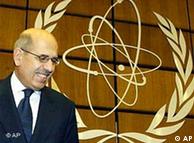
IAEA's Mohamed ElBaradei will be negotiating in Tehran this weekIAEA's Mohamed ElBaradei will be negotiating in Tehran this week


"The announcement by the Iranian authorities of the activation of 164 centrifuges is worrying," French Foreign Minister Philippe Douste-Blazy said in a statement. "If this announcement were confirmed, it would go directly against the repeated demands made by the IAEA and the United Nations Security Council."

The minister said France was awaiting the conclusions of a mission to Iran by IAEA head Mohamed ElBaradei, who leaves for Tehran Wednesday.

"Once again, I firmly urge Iran to suspend its dangerous activities in order to re-establish a relationship of trust with the international community," Douste-Blazy said.

Waiting for a "reliable signal"

Germany has been working with the five permanent members of the UN Security Council -- Britain, China, France, Russia and the United States -- to convince Tehran to freeze its enrichment program.

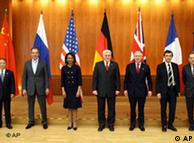
Germany and the five permanent members of the UN Security Council are aiming for a peaceful solutionGermany and the five permanent members of the UN Security Council are aiming for a peaceful solution


German foreign ministry spokesman Martin Jäger said Wednesday the negotiations had reached a "difficult phase."

He said the partners were waiting for a "reliable signal" that Tehran was willing to meet the UN Security Council deadline to freeze its enrichment activities, which runs out this month.

Jäger added that Germany still believed that a Russian proposal to enrich uranium for Iran on Russian soil could be "an important element of a possible solution."

In an elaborate ceremony Tuesday, the Islamic regime declared its scientists had managed to enrich uranium to make reactor fuel, in direct contravention of the UN Security Council demand for such work to stop.

This process, which can be extended to make weapons-grade uranium, is the focus of fears that Iran could acquire weapons of mass destruction. Tehran has consistently denied the charge.

Sheehan, Chavez bash Bush, Iraq war - Americas - MSNBC.com

Sheehan, Chavez bash Bush, Iraq war - Americas - MSNBC.com

Tres Amusant. Where do I sign up?

Anti-war mom, left-wing Venezuelan president meet at World Social Forum

Image: Cindy Sheehan and Venezuelan President Chavez
U.S. activist Cindy Sheehan, left, meets Venezuelan President Hugo Chavez during his weekly broadcast 'Alo Presidente' in Caracas on Sunday.

CARACAS, Venezuela - Cindy Sheehan, who gained international fame when she camped outside President Bush’s ranch in an anti-war protest, plans to pitch her tent again, Venezuela’s president said Sunday as he urged activists worldwide to help bring down “the U.S. empire.”

Hugo Chavez, an arm around Sheehan’s shoulders, told a group of activists that she had told him “she is going to put up her tent again in front of Mr. Danger’s ranch” in April.

In some of his strongest recent comments aimed at Washington, Chavez condemned the Bush administration and said his audience should work toward ending U.S. dominance.

“Enough already with the imperialist aggression!” Chavez said, listing countries from Panama to Iraq where the U.S. military has intervened. “Down with the U.S. empire! It must be said, in the entire world: Down with the empire!”

Chavez said Sheehan had invited him to join her April protest at Bush’s Crawford, Texas, ranch. Sheehan, whose 24-year-old soldier son Casey was killed in Iraq in 2004, held a vigil outside Bush’s ranch during the president’s vacation in August, attracting some 12,000 peace activists and reinvigorating the national anti-war movement.

“Maybe I’ll put up my tent also,” Chavez said, to applause from an audience invited to his weekly broadcast on the final day of the World Social Forum, an annual gathering of anti-war and anti-globalization activists.

Chavez said his government would help protest the war in Iraq by supporting a drive to gather petitions and delivering them to the U.S. Embassy in Caracas. Chavez, who before the war in Iraq had friendly relations with Saddam Hussein, has been a frequent and strident critic of the war.

Sheehan thanked Chavez for “supporting life and peace.” She said earlier that she was impressed by his sincerity when they met privately on Saturday.

“He said, ’Why don’t I run for president?”’ she said. “I just laughed.”

Sheehan also noted that singer and activist Harry Belafonte recently called Bush “the greatest terrorist in the world,” and said, “I agree with him. George Bush is responsible for killing tens of thousands of innocent people.”

Sheehan, who lives in Berkeley, Calif., said Saturday that she is strongly considering challenging Democratic Sen. Dianne Feinstein of California because the lawmaker will not support calls to immediately bring the troops home.

Sheehan, 48, who was visiting Venezuela for the six-day forum, said running in the Democratic primary in June would help “bring attention to all the peace candidates in the country.” She said she will decide whether to run after talking with her three adult children in California.

Feinstein’s campaign manager, Kam Kuwata, said the senator did not support Bush and felt she had been misled by his administration. But with troops committed, Feinstein believes immediate withdrawal is unworkable, he said.

“Senator Feinstein’s position is, ’Let’s work toward quickly turning over the defense of Iraq to Iraqis so that we can bring the troops home as soon as possible,”’ Kuwata said in an interview Saturday.

Also joining Chavez on Sunday was Elma Beatriz Rosado, the widow of slain Puerto Rican nationalist Filiberto Ojeda Rios. Holding back tears as she stood at Chavez’s side, Rosado accused the United States of killing her husband, a 72-year-old militant independence activist.

Rios was slain in a September FBI raid on a Puerto Rican farmhouse where he was living in hiding while being wanted for the 1983 robbery of $7.2 million from a Wells Fargo armored truck depot in Connecticut — funds intended for the independence cause.

“They murdered him,” Chavez said. “Viva Filiberto!... Let’s follow his example.”

Just don't get killed, this regime is already guilty of thousands and thousands of murders right here on US Soil.

Don't say it could never happen- Look up "Operation Northwoods", compare and contrast it to Sept. 11, 2001.

Guilty as Charged.


Photobucket